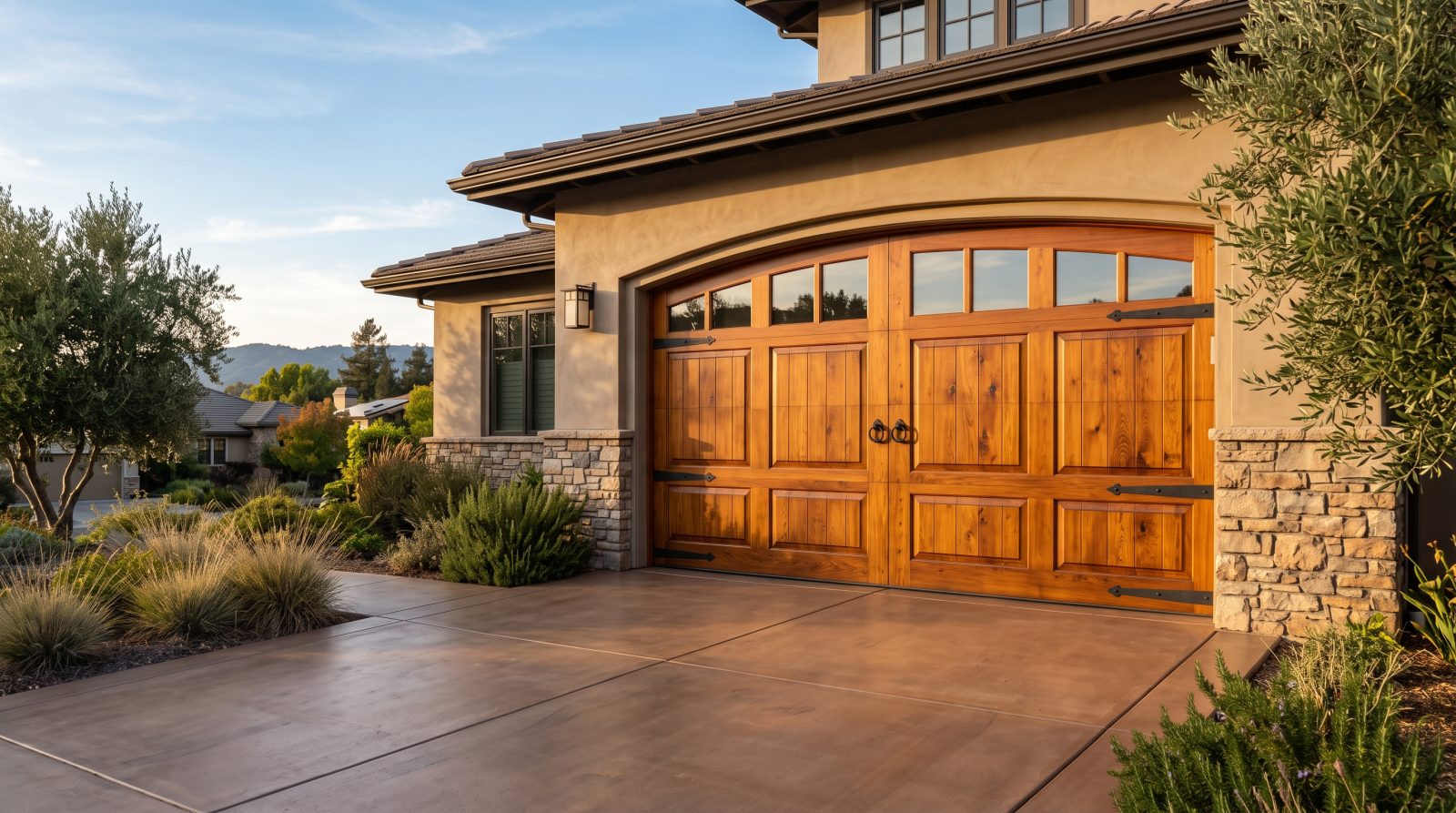
Why a real wood door looks different from everything else
The reason wood stops people on the sidewalk is simple physics: real wood has depth that printed and embossed finishes can't fake. Light enters the surface, scatters through the grain, and comes back to your eye with a three-dimensional quality. A steel door with a wood-look laminate is convincing from across the street, but it flattens out the closer you stand. A genuine wood door rewards a close look — that's the whole point of it.
There are two broad ways wood garage doors are built, and the difference matters for both looks and longevity. Solid-wood (sometimes called stile-and-rail) doors are framed sections of real lumber, often with raised or recessed panels — the most authentic and the most weight, which means the opener and springs have to be sized for it. Wood-overlay doors use a stable engineered or insulated core with a real wood skin or carriage-house overlay applied to the face, giving you much of the look with less seasonal movement and weight. Neither is 'better' in the abstract; they're different answers to the same question of how much real wood you want versus how much upkeep you're signing up for.
Wood is also the most customizable material on the market. Species, stain, panel layout, glass, clavos and strap hardware, and the choice between a classic raised-panel and a flat modern slab are all on the table. That flexibility is why architects and designers reach for wood when a door needs to match a specific home rather than just fill an opening.
- Solid stile-and-rail: most authentic, heaviest, most seasonal movement — spring and opener must be sized for the real weight
- Wood-overlay on a stable core: real wood face, far less warping, lighter, often insulated — a strong fit for hot-facing or coastal exposures
- Species and stain choice let you match Craftsman, Spanish, mid-century, farmhouse, or modern architecture exactly
- Glass top sections and authentic hardware (clavos, handles, straps) turn a door into a design feature, not just an entry
Choosing a wood species for a Bay Area home
Species is the decision that drives both the look and how the door behaves outdoors, so it's worth slowing down on. Western red cedar is the most common premium choice for a reason: it's naturally lighter than many hardwoods, it's relatively stable, it resists rot and insects better than most softwoods, and it takes stain beautifully. For a lot of Bay Area homes it's the default for good reason. Redwood shares many of cedar's strengths and has deep regional roots in California architecture, with a warm reddish tone that suits older homes.
Mahogany and other hardwoods give you a richer, more formal grain and exceptional durability, but they're heavier and pricier — and that weight feeds back into the spring and opener spec. Hemlock and fir are more budget-friendly and paint well, which makes them a good pick if you're planning a solid painted color rather than a stained finish that shows grain. If your design calls for a painted door, you don't necessarily need to pay for a show-grade species; paint hides grain anyway, so the money is better spent on construction quality and a good primer system.
The unglamorous truth is that exposure matters as much as species. A west- or south-facing door in Walnut Creek or San Jose bakes in afternoon sun and UV; a door a few miles from the coast in Pacifica or the Sunset deals with salt air and fog-driven moisture instead. We talk through your door's actual orientation and microclimate on site, because the right species plus the right finish plus the right exposure is what determines whether you're refinishing every few years or much less often.
- Western red cedar: stable, naturally rot- and insect-resistant, takes stain well — a common Bay Area premium pick
- Redwood: warm California classic, similar strengths to cedar, suits older and Craftsman homes
- Mahogany/hardwoods: richest grain and durability, but heavier and more expensive — affects spring/opener sizing
- Hemlock/fir: budget-friendly and paint-grade — best when you're painting a solid color rather than staining
What a wood garage door typically costs
Wood is the premium tier of the garage door market, and it's honest to say so up front. As a rough industry range — and these are estimates that vary widely by door size, species, construction, glass, hardware, insulation, and how much prep your opening needs — a wood-overlay door installed often lands in the low-to-mid four figures, while a true custom solid-wood door can run from the mid four figures into five figures for large, multi-car, premium-species builds. A single-car overlay door is at the low end; a custom two- or three-car solid mahogany door with glass and ironwork is at the high end. Your exact number depends on choices only you can make, which is why we quote on site after measuring rather than guessing.
A few cost drivers are easy to underestimate. Weight is the big one: a heavy solid-wood door usually needs a correctly rated spring system and may need an opener with enough lifting force and the right horsepower or DC equivalent, so the door isn't the only line item. Custom sizing for the older, non-standard openings common in Bay Area homes can add cost. And the finish is part of the real price of ownership — budget for periodic refinishing as part of the lifetime cost, not just the purchase.
It's worth weighing wood honestly against the alternatives. Steel and composite carriage-house doors cost less and ask for far less maintenance, and modern faux-wood finishes are genuinely good. If you want the look with minimal upkeep, those deserve a real look. People choose wood anyway because nothing else has the same authenticity and presence — and on the right home, that presence shows up in how the whole property reads. We'll give you the straight comparison so you're choosing wood for the right reasons.
- Wood-overlay (real wood face, stable core): typically low-to-mid four figures installed — the value entry point to real wood
- Custom solid-wood: mid four figures up into five figures for large, premium-species, glass-and-iron builds
- Hidden drivers: heavier doors need correctly rated springs and a strong-enough opener; non-standard openings add cost
- Lifetime cost includes refinishing — budget for upkeep, not just the install
- All figures are general industry estimates that vary by region, door, material, and scope — not a fixed quote
How the Bay Area climate actually treats wood
Wood lives and breathes with the weather, and the Bay Area hands a wood door a more varied diet than most regions because we have so many microclimates packed into a small area. The common thread is that wood expands when it takes on moisture and contracts when it dries — and our wet winters followed by long dry summers put a door through that cycle every year. The enemy isn't any single condition; it's the repeated swing, and a sound finish is what slows it down.
Near the coast — Pacifica, the Outer Sunset, parts of the Peninsula and Marin — the issue is persistent moisture and salt-laden fog. Wood here wants a finish that seals well against humidity, and salt air is harder on both the wood and the metal hardware, so stainless or well-protected fasteners and hinges earn their keep. Inland and in the hotter valleys — much of the East Bay, the South Bay, the 680 and 24 corridors — the bigger threat is UV. Direct afternoon sun fades stain and breaks down unprotected finishes faster than people expect, especially on west- and south-facing doors. A UV-resistant exterior finish isn't optional on a sun-baked elevation; it's the difference between a door that holds its color and one that goes gray and chalky.
The practical takeaway is that the same door behaves differently two towns apart, so the finish and maintenance plan should be matched to your specific exposure rather than copied from a generic care sheet. That's something we look at directly when we measure — which way the door faces, how much sun and fog it really gets, and what that means for the finish system and how often you'll want to refresh it.
- The damage comes from the wet-winter / dry-summer moisture swing, not any single condition — a good finish slows it
- Coastal (fog, salt air): seal against humidity; use corrosion-resistant hardware and fasteners
- Inland/valley (intense sun): UV-resistant finish is essential, especially on west- and south-facing doors
- Same door, different town, different upkeep — match the finish and schedule to your actual exposure
Keeping a wood door looking new: real maintenance
Here's the part that decides whether you love your wood door in ten years or regret it: the finish is a wear surface, and maintaining it on schedule is far easier and cheaper than rescuing a neglected door. A door that gets a fresh coat before the finish fails stays beautiful for a long time. A door that's allowed to go gray, crack, and let water in needs sanding, possible repair, and full refinishing — or eventually replacement. The whole game is staying ahead of the wear.
Routine care is genuinely light. Wash the door a couple of times a year with mild soap and water to clear off dust, pollen, and — near the coast — salt residue, then rinse and let it dry. Walk the surface once or twice a year and look for the early warning signs: dull or fading color, a chalky feel, hairline cracks in the finish, or any spot where water beads less than the rest of the door. Those are the cues to recoat before bare wood is exposed. Pay special attention to the bottom panels and bottom edge, which take the most splash and standing moisture.
How often you refinish depends almost entirely on exposure. A protected, north-facing or covered door can go several years between coats; a fully exposed, west-facing door in strong sun may want attention more often. Beyond the finish, the moving parts deserve the same care any door needs: keep the rollers, hinges, and tracks clean, lubricate the metal moving parts periodically, and have the springs and balance checked — a heavy wood door is unforgiving of a worn or mismatched spring, and an out-of-balance door strains both the opener and the door itself. If you'd rather not get on a ladder, this is exactly the kind of seasonal check we handle on a service visit, anywhere we travel in the Bay Area.
One more honest note: catch problems early. A small finish failure is a recoat; the same spot ignored becomes water intrusion, then swelling or rot, then a repair or a replacement panel. Wood is forgiving if you respect the schedule and unforgiving if you don't — and that's the real deal you're making when you choose it.
- Wash 1–2x a year with mild soap and water; rinse off coastal salt residue and let it dry fully
- Inspect for early warning signs: fading color, chalky feel, hairline finish cracks, water no longer beading
- Refinish on a schedule set by exposure — protected doors go years, sun-baked west-facing doors need it sooner
- Watch the bottom panels and edge most closely — they take the heaviest splash and standing moisture
- Keep rollers/hinges/tracks clean and lubricated, and have the springs and balance checked — heavy doors punish a worn spring
- Recoat before bare wood shows: a small finish fix is cheap; water intrusion and rot are not