What R-Value Actually Means (and Where the Numbers Get Misleading)
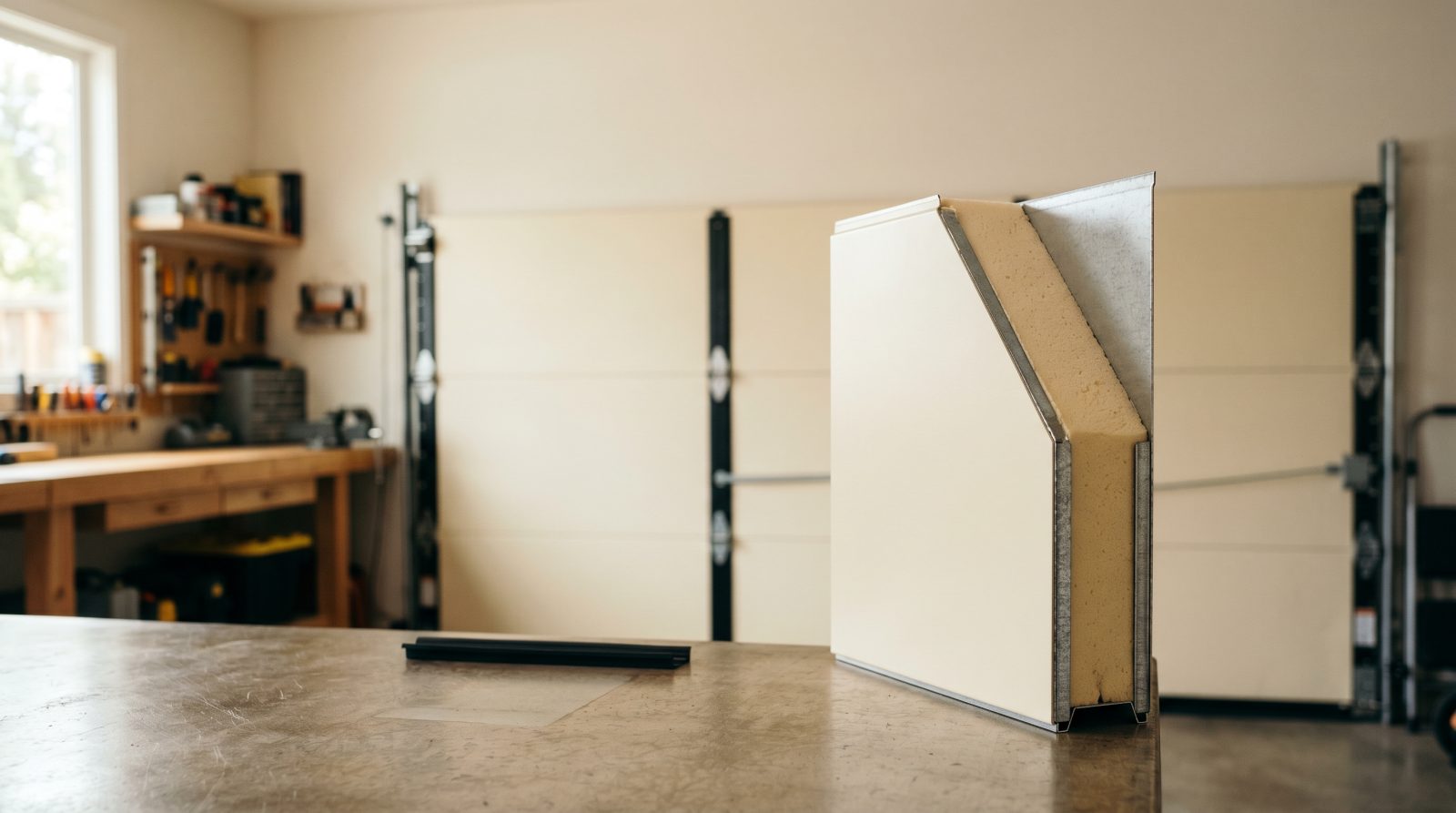
R-value measures how well a material resists heat flow. The higher the number, the slower heat moves through the door, which is exactly what you want whether you're keeping summer heat out or workshop warmth in. A bare single-layer steel door has an R-value close to zero; it's essentially a metal sheet that conducts whatever temperature is on the other side. Add a layer of polystyrene or polyurethane foam and that number climbs, with polyurethane (injected and expanded to bond to the panel) generally delivering more insulation per inch than polystyrene (rigid foam boards slotted into the panel).
Here's where buyers get burned: many manufacturers quote a 'calculated' R-value for the center of the panel, not the whole door. The real-world figure once you account for the seams, the perimeter, the windows, and the gaps around the frame is almost always lower. Two doors both advertised at 'R-12' can perform very differently depending on construction quality and how well the door seals to the opening. The seal matters enormously. An R-18 door with a worn bottom gasket and no perimeter weatherstripping will underperform a modest R-9 door that's sealed tight, because air leakage moves heat far faster than conduction through foam.
For most Bay Area homes, you don't need the highest number on the shelf. You need an honest, well-constructed door matched to your climate and how attached the garage is to your living space.
- R-6 to R-9: Entry-level insulation, good for detached garages or mild coastal zones where you mainly want some buffering and quieter operation.
- R-9 to R-13: A strong middle ground for attached garages and homes with living space above or beside the garage, the most common Bay Area sweet spot.
- R-13 to R-18+: Best for inland heat (Concord, Antioch, Livermore), converted garage rooms, gyms, and workshops where you actively heat or cool the space.
- Watch for 'center-of-panel' R-value claims; ask what the whole-door performance is and how the door seals to the opening.
Single-Layer, Double-Layer, and Triple-Layer Construction
The phrase 'insulated garage door' covers three very different builds, and knowing them keeps you from overpaying or under-buying. A single-layer door is just steel (or aluminum, or wood) with no insulation; it's the lightest, cheapest, and loudest, and it transmits outside temperature almost directly. A double-layer door sandwiches a layer of foam insulation behind the steel face, which improves R-value, deadens sound, and adds rigidity. A triple-layer door adds a second steel or composite skin on the inside, fully encasing the foam, giving you the best insulation, the quietest operation, the most durable interior finish, and the heaviest, most solid feel when the door opens and closes.
That added mass in triple-layer doors does more than insulate. It resists dents, stands up to a stray basketball or a backed-into bumper, and feels noticeably more substantial. For an attached garage that shares a wall or ceiling with bedrooms or a home office, the noise reduction alone is often reason enough to step up a tier. The trade-off is weight: heavier doors place more demand on the springs and opener, which is why a proper install includes confirming your spring system and opener are matched to the new door's weight rather than just bolting the door on.
There's no single 'best' construction; there's the right one for your use. A rarely-entered detached garage in a temperate microclimate rarely justifies triple-layer, while a garage gym in the East Bay heat almost always does.
- Single-layer: lowest cost, no real insulation, loudest, lightest; fine for purely utilitarian detached garages.
- Double-layer (steel + foam): the most popular insulated choice; better R-value, quieter, more rigid, modest cost step-up.
- Triple-layer (steel + foam + steel/composite): best insulation and sound control, durable interior, premium feel; heaviest.
- Heavier insulated doors require correctly matched springs and opener capacity, verified at install, not assumed.
Why Insulation Matters Differently Across Bay Area Microclimates
The Bay Area isn't one climate; it's dozens packed into a small footprint, and the right door changes block to block. Along the coast and through San Francisco's Sunset and Richmond districts, the issue is rarely scorching heat; it's persistent fog, damp chill, and wind. Here, insulation buys you a more comfortable workshop or laundry-garage and helps keep that marine moisture and cold from radiating into attached living space. A sealed, insulated door also cuts the draft that makes a foggy-morning garage feel ten degrees colder than the thermostat reads.
Move inland and the math flips. In Concord, Walnut Creek, Antioch, Brentwood, Livermore, and much of the East Bay, summer afternoons routinely push well into the 90s and beyond. A south- or west-facing single-layer steel door turns into a radiator, dumping heat into the garage and into any rooms that share its walls. An insulated door meaningfully slows that heat transfer, which matters most when the garage is attached to living space, has a room above it, or has been converted into an office, gym, or ADU. On the Peninsula and in parts of Marin and the South Bay, the bigger driver is often noise: insulated, multi-layer doors dampen road, freeway, and neighborhood sound far better than a hollow single-layer slab.
Because we're mobile and come to your home, we can look at your actual exposure: which way the door faces, what's on the other side of the wall, how the garage is used, and the microclimate on your street, rather than recommending a one-size door from a catalog.
- Coastal/SF (Sunset, Richmond, Pacifica, Daly City): fog, damp, and wind; insulation buffers chill and draft for workshops and attached rooms.
- Inland East Bay (Concord, Antioch, Livermore, Brentwood): real summer heat; insulation protects attached living space and garage conversions.
- Peninsula, South Bay, Marin: noise reduction from roads and freeways is often the leading benefit.
- Garage conversions and ADUs anywhere: prioritize higher R-value plus tight sealing, since the space is now lived-in.
Energy Savings, Comfort, and the Limits of What a Door Can Do
Let's be honest about energy savings, because the industry tends to overpromise. An insulated garage door does not, by itself, slash your whole-home energy bill, especially for a detached garage you don't heat or cool. The meaningful savings show up when the garage is attached and shares conditioned walls or a ceiling with living space, when you actively heat or cool the garage, or when the garage door is the single largest uninsulated surface on that side of the house, which it very often is. In those cases, slowing heat transfer through the door reduces how hard your HVAC works on the adjacent rooms, and the comfort improvement is immediate and noticeable.
Comfort is frequently the bigger win than the dollar figure. An insulated garage stays closer to a usable temperature year-round, which transforms how the space functions: a workshop you'll actually use in January, a gym that isn't an oven in August, a laundry area that doesn't feel like a wind tunnel. Multi-layer insulated doors are also dramatically quieter, both in operation (less rattle and vibration) and as a sound barrier, which is a genuine quality-of-life upgrade when bedrooms or offices sit nearby.
Insulation also protects the door itself. The rigid foam core makes panels stiffer and more dent-resistant, and the bonded construction holds its shape better over years of daily cycling. To get the full benefit, though, the door is only half the system: weatherstripping around the perimeter, a fresh bottom seal, and, where appropriate, insulating the walls and the connecting door between the garage and house all work together. A premium insulated door installed against unsealed gaps leaves real performance on the table.
- Biggest energy benefit: attached garages, conditioned garages, and large sun-facing door openings.
- Smaller energy benefit: detached, unconditioned garages, where comfort and quiet are the main payoffs.
- Comfort and noise reduction are often the deciding factors, not the utility-bill math alone.
- Maximize results by pairing the door with perimeter weatherstripping, a good bottom seal, and an insulated house-to-garage door.
Choosing the Right Insulated Door and Our Mobile Install Process
Picking an insulated door comes down to a short, honest set of questions: How is the garage used, now and in the next few years? Is it attached to living space or a room above? Which direction does the door face, and how much sun or fog hits it? Is noise a problem? Once those are clear, the right construction tier and R-value range usually become obvious, and you avoid both under-buying (a thin door that won't deliver the comfort you wanted) and over-buying (paying for triple-layer on a detached shed you enter twice a week).
Material matters too. Steel is the most common, durable, and cost-effective face for insulated doors and takes a wide range of finishes. Composite and faux-wood overlays give the warmth of wood with better stability in Bay Area moisture swings. Glass and aluminum sections can be insulated as well, though large window sections are inherently weaker thermal points, so they're a styling-versus-performance trade-off worth discussing for your specific exposure.
As a fully mobile service, we bring the consultation and the installation to your home. We measure the actual opening, assess your existing track, springs, and opener to confirm they'll handle the weight of an insulated door, and walk you through realistic options for your microclimate and budget. Pricing for an insulated garage door varies with size, single versus double versus triple-layer construction, material, window options, and whether spring or opener work is needed, so figures from any source should be treated as typical industry estimate ranges, not a fixed quote; we provide a clear, itemized estimate after seeing your door. If you're upgrading from a worn single-layer door, expect the new insulated door to feel quieter and more solid the first time it cycles. When you're ready, reach out for a free, no-pressure quote and we'll come to you.
- Match construction to use: detached/utilitarian leans single or double-layer; attached, conditioned, or converted spaces lean double or triple-layer.
- Steel for durability and value; composite/faux-wood for looks with moisture stability; large glass sections trade thermal performance for style.
- We verify your springs and opener can carry the heavier insulated door, included in a proper install.
- Costs vary by size, layer count, material, and any spring/opener work; treat published numbers as estimate ranges and get an on-site itemized quote.
- Mobile service: we measure, advise, and install at your home, then you decide. Call for a free quote.