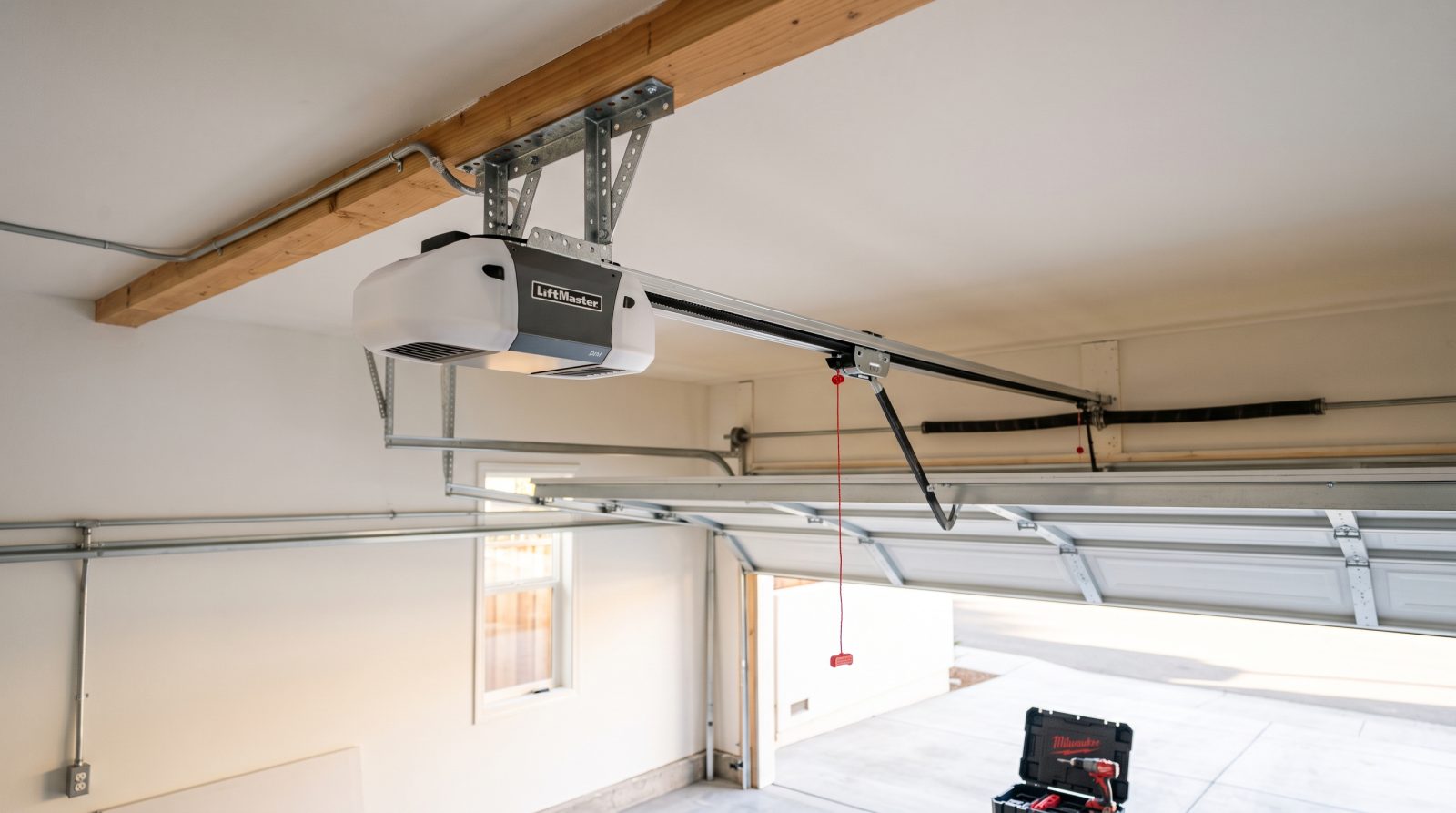
What a Garage Door Opener Actually Does (and Doesn't Do)
Here's the single most useful thing to understand before you buy anything: the opener does not lift the weight of your door. That job belongs to the springs mounted above or alongside the door. A correctly balanced door is effectively weightless because the springs counterbalance it. The opener's real job is just to guide that balanced door up and down and hold it in position. This matters enormously, because a new opener bolted onto a door with worn or mis-sized springs will strain, run hot, and fail early, no matter how good the motor is.
That's why a real installation starts with a balance check, not a wrench. We disconnect the door from the opener and lift it by hand. A healthy door should move smoothly and stay put around waist height when you let go. If it slams down or rockets up, the springs are off, and that needs addressing before or alongside the opener swap. Skipping this step is the most common reason a brand-new opener disappoints, and it's a corner we won't cut.
Modern openers also carry safety hardware that older units lack. Federal safety standards have required photo-eye sensors near the floor since 1993, so the door reverses if something crosses the beam, plus an automatic force-reversal if the door meets resistance on the way down. If your current opener predates these features or the sensors no longer work reliably, that alone is a strong reason to replace rather than repair, especially in a home with kids, pets, or a busy driveway.
- Springs lift the door; the opener only guides and holds it
- A pre-install balance check protects your new motor and the manufacturer warranty
- Photo-eye sensors and auto-reverse are safety standards, not upgrades
- An opener is only as reliable as the door hardware behind it
Chain vs. Belt vs. Screw Drive: An Honest Comparison
The drive system is how the opener transmits power from the motor to the trolley that pulls the door. There are three common types, and the right one depends mostly on your home's layout, how much noise you can tolerate, and how often the door gets used. None of them is universally 'best'; each is best for a particular situation.
Chain drives use a metal chain, much like a bicycle chain, to move the trolley. They're the most affordable and proven workhorses, and they handle heavy doors well. The trade-off is noise and vibration. In many Bay Area homes that's a non-issue, but it becomes one fast when there's a bedroom directly above or beside the garage, which is extremely common in the multi-level townhomes and newer infill builds around San Jose, Oakland, and the Peninsula. If your garage shares a wall or ceiling with living space, a chain drive may keep someone up at night.
Belt drives swap the chain for a reinforced rubber belt. They run noticeably quieter and smoother because there's no metal-on-metal contact, which makes them the popular choice for attached garages and homes where the opener cycles during sleeping hours. They typically cost a bit more than a chain drive, but for most Bay Area homeowners with an attached garage, the quiet operation is well worth it. They lift just as capably as a chain unit.
Screw drives use a threaded steel rod to move the trolley, with fewer moving parts and few maintenance demands. They can be a reasonable middle ground, though their performance is more sensitive to temperature swings. That's rarely a problem in the Bay Area's mild, narrow temperature band, but they remain less common than belt or chain. Lastly, newer wall-mount (jackshaft) openers mount beside the door rather than on the ceiling, freeing overhead space and running very quietly, which is ideal for garages with high or obstructed ceilings, storage racks, or a car lift.
- Chain drive: lowest cost, very durable, loudest; fine for detached garages
- Belt drive: quiet and smooth, modest premium; ideal under or beside living space
- Screw drive: few moving parts, low upkeep; more temperature-sensitive
- Wall-mount (jackshaft): clears the ceiling, runs quiet; great for tight or tall garages
Smart Openers: What's Genuinely Worth It
Most new openers now offer Wi-Fi connectivity and a smartphone app, and the features have matured past gimmick territory. The core benefit is simple and real: you can check whether the door is open and close it from anywhere. If you've ever driven halfway to work wondering whether you left the garage wide open, that one feature pays for itself in peace of mind, and it's especially handy for households juggling commutes across the bridges and down the freeways where turning back isn't a five-minute affair.
Beyond remote control, the genuinely useful smart features include real-time alerts when the door opens or closes, the ability to grant temporary access to a house cleaner, dog walker, or delivery without handing out a physical remote, and activity logs so you can see when the door cycled. Many models integrate with popular smart-home and voice platforms, and some support package-delivery workflows. Battery backup, while not strictly a 'smart' feature, is worth flagging here too: it keeps your door operable during a power outage, which is a sensible consideration given how often Bay Area homeowners deal with planned grid shutoffs.
Our honest take: don't overbuy. If you want quiet, reliable daily operation and the ability to confirm the door is closed from your phone, a mid-range belt-drive smart opener with battery backup covers what the vast majority of homeowners actually use. The highest-end feature tiers add capabilities many people never touch. We're happy to walk through which features map to how you'll really use the door, then install only what serves you.
- Remote open/close and 'is it closed?' status checks from anywhere
- Open/close alerts and timestamped activity history
- Temporary, revocable access for helpers and deliveries; no spare remotes to lose
- Battery backup keeps the door working through a power outage
What a Proper Installation Includes
A new opener is not a plug-and-play swap, and the difference between a quick bolt-on and a careful installation shows up months later. A complete installation starts with that door balance and spring check, then includes removing and hauling away the old unit, mounting the new motor head securely to the structure, installing or reusing the rail and trolley, and wiring and aligning the photo-eye safety sensors so they protect the opening reliably.
From there, the details matter: setting the open and close travel limits so the door seals at the bottom without straining at the top, calibrating the force settings so the auto-reverse triggers correctly on contact, programming your remotes, exterior keypad, and in-car buttons, and connecting the unit to your home Wi-Fi and app if it's a smart model. We finish by cycling the door multiple times, testing the safety reversal with a physical obstruction, and walking you through how to use everything, including the manual release in case of a power loss.
We bring the tools, ladders, and hardware to you anywhere in the Bay Area, work cleanly, and leave the garage tidy. Because we're mobile, we can also handle the common 'while you're here' items in the same visit, like fresh rollers, worn weatherstripping, or a spring concern surfaced during the balance check, so you're not scheduling three separate appointments for one door.
- Door balance and spring inspection before any motor goes up
- Old unit removal and haul-away included
- Travel limits, force settings, and safety sensors properly calibrated
- Remotes, keypad, and app set up; door tested and demonstrated before we leave
What Opener Installation Typically Costs in the Bay Area
Pricing depends on the opener you choose, the drive type, whether your existing rail and hardware can be reused, and the condition of the door and springs. As a general guide, professional installation of a new opener commonly falls in the range of roughly $400 to $800 including the unit and labor, with chain drives at the lower end and quiet belt-drive smart openers with battery backup toward the upper end. These are typical industry estimates, not a quote, and your actual price varies with the equipment, your door, and the scope of work.
A few things can shift the number. If your springs, cables, or rollers are worn and need attention to give the new opener a fair chance, that adds to the total but saves you from a premature failure. Conversely, if your current rail and mounting are sound and compatible, reusing them can keep costs down. Very heavy doors, custom or oversized openings, and wall-mount jackshaft installations sit at the higher end because of the equipment involved.
The smarter way to think about it isn't the lowest sticker price, it's the total cost of a door that works quietly and safely for years. A correctly sized opener installed on a well-balanced door simply lasts longer and breaks less. We'll give you a clear, no-pressure estimate for your specific situation before any work begins, so you know what to expect. Call for a free quote and we'll come take a look.
- Typical installed range: about $400 to $800 (estimate, varies by door and unit)
- Drive type and smart features move the price within that band
- Worn springs/cables/rollers may add cost but protect the new motor
- Reusing sound existing rail and mounts can reduce the total