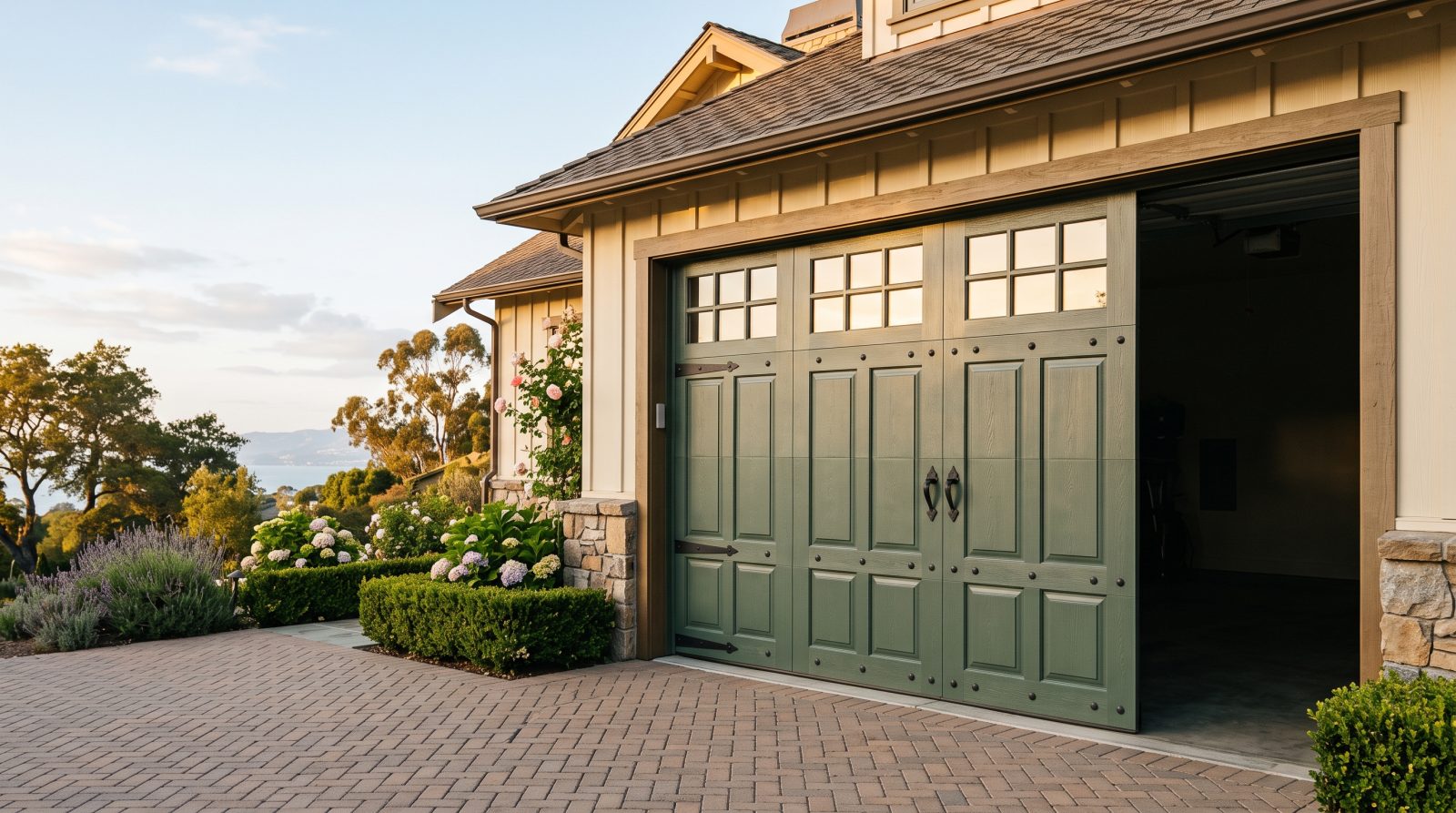
What a carriage house garage door actually is
The phrase "carriage house" describes a look, not a single mechanism. True carriage doors from a century ago were two slabs hinged on the sides that swung outward like a gate, originally built to house horse-drawn carriages. They looked beautiful but were impractical: they needed clearance to swing into the driveway, they sagged over time, and they were difficult to automate. Modern carriage house garage doors keep that classic appearance but are engineered as standard overhead doors. They are built in horizontal sections, ride up on rollers and tracks, and tuck flat against your garage ceiling, so they work with any standard opener and never swing into the path of a parked car.
The carriage character comes from the details rather than the motion. Decorative hardware such as wrought-iron-look hinges, handles, and clavos (the rounded studs you see on old wooden gates) are mounted to the face. Many doors are divided into vertical panels separated by a center seam so they read as two doors meeting in the middle, and a top row of windows often completes the barn-door or stable-door feel. From the street, the door looks like it swings; in reality it rolls up overhead like every other modern garage door.
There is also a genuine swing-out and slide-to-side version still available for purpose-built carriage houses and detached structures. We can source and service those too, but for the vast majority of Bay Area homes the overhead-operating carriage door is the right call because it preserves driveway space, seals tightly against wind and rain, and automates cleanly.
- Overhead carriage doors: classic appearance, modern sectional operation, works with any opener
- Swing-out / slide carriage doors: authentic motion, needs swing clearance, harder to weather-seal and automate
- Defining details: faux hinges and handles, clavos, a center divide, and an optional row of top windows
Materials that hold up in Bay Area conditions
Material choice matters more here than in a lot of the country because the Bay Area is really several microclimates stacked close together. A door a few blocks from the water in Alameda, Sausalito, or Pacifica lives in salt air and fog that punish raw steel and untreated wood, while a home in the warmer inland valleys around Livermore, Walnut Creek, or San Jose sees stronger sun and bigger daily temperature swings that can fade finishes and stress panels. The carriage look is available in every major material, and the right one depends on where your home sits.
Steel carriage doors are the most common and the most practical. A quality insulated steel door with a textured, wood-grain-look finish gives you the carriage appearance at a sensible price, resists warping, and needs little upkeep. For coastal homes, look for doors with strong factory paint or composite-clad faces, since salt air is the enemy of bare metal. Faux-wood composite and fiberglass-overlay doors are the sweet spot for many Bay Area homeowners who want the depth and grain of real wood without the maintenance: they shrug off moisture and fog and resist the swelling and cracking that natural wood can suffer near the coast.
Real wood carriage doors, typically built from cedar, redwood, or hemlock with stain-grade or paint-grade finishes, are the most beautiful and the most demanding. They suit higher-end homes and historic neighborhoods where authenticity is the point, but they want periodic refinishing, and in a damp, foggy microclimate that schedule comes around faster. We are happy to install and maintain wood doors; we just make sure you go in with clear eyes about the upkeep. Insulation is worth considering on any material if your garage is attached, used as a gym or workshop, or shares a wall with living space, since it steadies the temperature and dampens street noise.
- Insulated steel: best all-around value, low maintenance, available in convincing wood-grain finishes
- Composite / fiberglass overlay: real-wood look that resists fog, salt air, and moisture with little upkeep
- Natural wood (cedar, redwood, hemlock): most authentic and striking, but needs regular refinishing, especially near the coast
- Coastal homes (Alameda, Sausalito, Pacifica, Half Moon Bay): favor composite or strongly finished steel over bare metal or raw wood
Matching the style to your home and neighborhood
A carriage door earns its keep on curb appeal, so the goal is a door that looks like it was always part of the house, not bolted on afterward. The single biggest decision is the panel layout and window pattern, because that is what your eye reads from the curb. Short, square panel grids with arched or rectangular top windows lean traditional and pair well with Craftsman, Tudor, and Spanish-influenced homes that are common throughout the East Bay and South Bay. Cleaner, flatter carriage doors with minimal hardware and simple glass bridge the gap toward modern and transitional homes you see in newer Peninsula and Silicon Valley developments.
Color and finish should take cues from the rest of the house. A stained wood-look door warms up light stucco and white trim, while a painted door in a deep, saturated tone can tie into shutters, the front door, or window frames. In neighborhoods with an HOA, and there are many across the Bay Area, double-check that your color, hardware, and window choices are within the guidelines before you order, since custom carriage doors are typically non-returnable. Bringing the door selection to your driveway, which is how we work, makes this much easier because you can hold finishes against your actual siding and trim in real daylight instead of guessing from a small swatch under store lighting.
Hardware is the finishing touch. Decorative handles, hinges, and clavos in matte black or oil-rubbed bronze are what sell the carriage illusion, and a little restraint usually looks more expensive than piling everything on. If you are matching two single doors or a double-wide door across a three-car garage, keep the spacing and window lines consistent so the whole facade reads as one intentional design.
- Panel and window pattern drive the look more than anything else, choose it for your home's architecture
- Traditional homes (Craftsman, Tudor, Spanish): square grids, arched or divided-light top windows, visible hardware
- Modern and transitional homes: flatter panels, simple glass, minimal hardware
- Confirm HOA rules on color, glass, and hardware before ordering, custom carriage doors usually cannot be returned
Installation, repair, and what we handle on-site
Because carriage doors are real overhead doors, they involve the same load-bearing system as any sectional door: springs that counterbalance the weight, cables, rollers, hinges, tracks, and an opener. The decorative carriage hardware is cosmetic, but the spring and cable system is under high tension and is the part that demands experience and the right tools. Spring and cable work in particular is genuinely dangerous to attempt without proper training, so it is one of the main reasons homeowners call a pro rather than treating a carriage door like a weekend project.
On a typical install we measure your opening precisely, confirm headroom and side-room for the tracks, remove and haul away the old door if needed, set the new sections, balance the springs to the door's weight, true up the tracks, and tune the opener so the door travels smoothly and reverses safely on contact. Getting the balance right is what makes a heavy carriage door feel light and what keeps your opener from wearing out early. For heavier real-wood doors, that balancing step matters even more, and we size the spring system to the actual door rather than guessing.
We also repair carriage doors that are already on the home: replacing broken springs, frayed cables, worn rollers, and bent track sections; re-securing or replacing loose decorative hardware; swapping cracked window inserts; fixing doors that bind, sag, or come off the track; and dialing in noisy or erratic openers. As a mobile service we carry common parts with us and aim for same-day help on the failures that leave you stuck, so a snapped spring or a door that won't close doesn't strand your car in the garage.
- What we install: full carriage door systems sized and balanced to your opening and door weight
- What we repair: broken springs and cables, worn rollers and hinges, bent tracks, sagging or off-track doors
- Cosmetic fixes: loose or damaged decorative hardware and cracked window inserts
- Safety note: spring and cable work is high-tension and best left to a trained technician, not a DIY repair
What carriage house garage doors typically cost
Pricing for carriage house doors covers a wide range because the look is available from value steel all the way up to custom real wood, and labor varies with the size of the opening, the condition of the existing framing and tracks, and whether an opener is part of the job. The figures below are typical industry ranges to help you plan, not a quote; your actual price depends on your specific door, material, size, hardware, and the scope of work, and we confirm everything with an on-site estimate before anything is ordered.
As a rough planning guide, an insulated steel carriage-style door installed for a standard single-car opening commonly lands in the lower-to-mid range, composite and fiberglass-overlay doors sit in the middle, and custom real-wood carriage doors reach the top of the range, especially in larger double or triple sizes. Decorative hardware packages, upgraded window glass, insulation, and a new opener are the most common add-ons that move the number. Repairs are generally far less than a replacement: a spring or cable repair, roller replacement, or track adjustment is usually a modest service cost rather than a major investment.
The most reliable way to budget is to have us look at the actual opening. We measure on-site, check the framing, tracks, and opener, talk through material and style options against your home, and put together a clear estimate so there are no surprises. When the door arrives we install and balance it, then walk you through the safety reverse and basic care so it lasts. Call for a free estimate to get started.
- Insulated steel carriage doors: typically the most budget-friendly option
- Composite / fiberglass-overlay: usually mid-range, with a convincing wood look and low upkeep
- Custom real-wood carriage doors: top of the range, more so in double and triple-wide sizes
- Common add-ons: decorative hardware, upgraded glass, insulation, and a new opener
- All figures are typical estimates that vary by door, material, size, and scope, confirmed by an on-site estimate