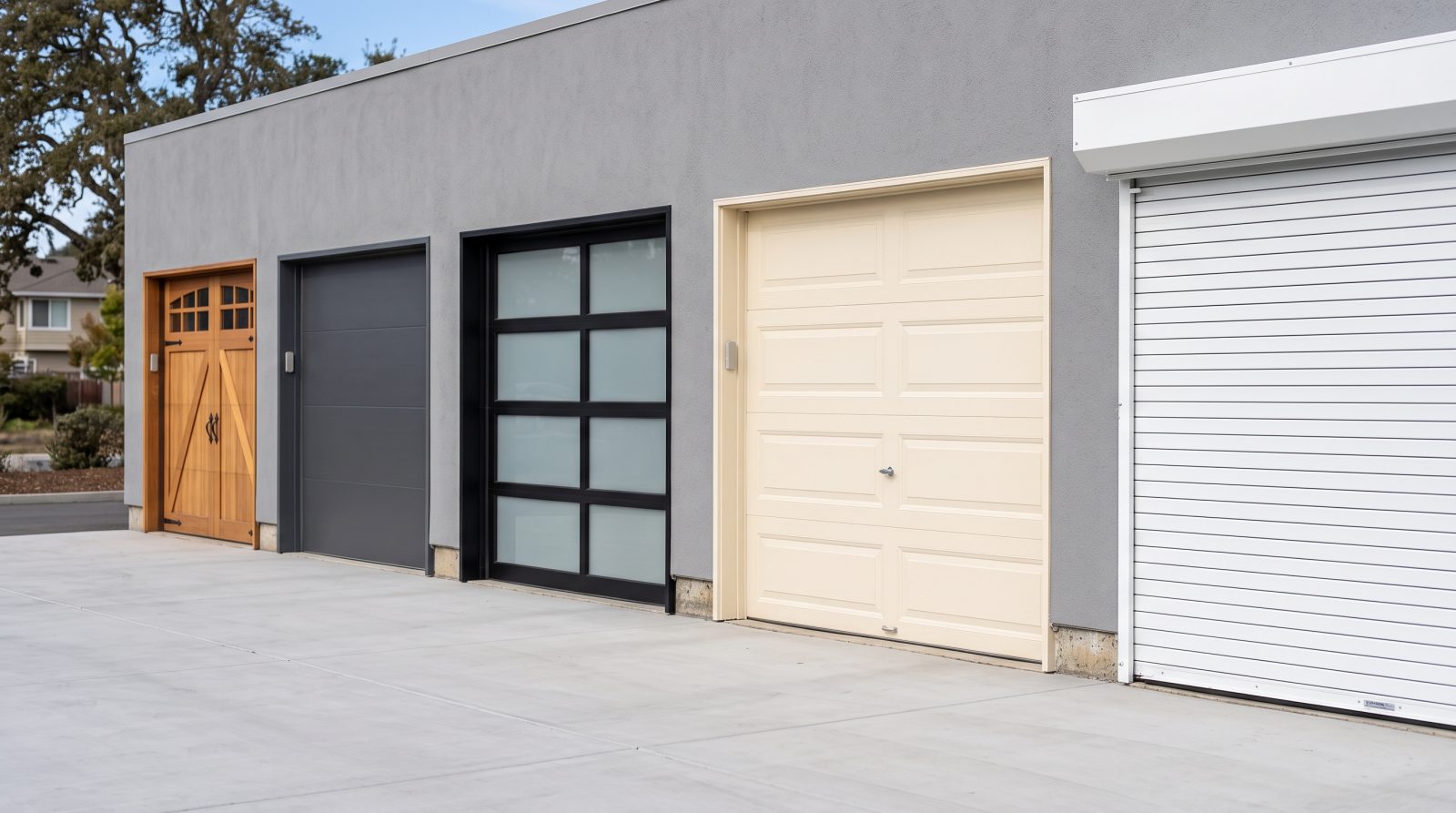
Start With Material: Steel, Aluminum, Wood, Composite, or Fiberglass
Material is the foundation decision because it drives durability, maintenance, weight, insulation potential, and price. The Bay Area's defining variable is moisture and salt. Homes near the coast and bay — Pacifica, the Outer Sunset, Alameda, the Peninsula shoreline — sit in salt-laden marine air that accelerates corrosion and chews through cheap finishes, while inland valleys like the Tri-Valley and South Bay see more sun and heat that can fade and warp lesser materials. The best material for you depends heavily on which of those worlds your house lives in.
Steel is the most common choice for good reason: it's strong, available in nearly every style, and modern multi-layer steel doors with baked-on or vinyl-bonded finishes resist corrosion far better than older single-skin panels. The trade-off is that bare or scratched steel near salt air can rust, so coastal homeowners should prioritize galvanized, primed-and-painted, or composite-faced steel. Aluminum with glass is popular for modern Bay Area remodels and Eichler-style homes — it won't rust, stays light, and creates that contemporary frosted-glass look, but it dents more easily and insulates poorly unless paired with thermal breaks. Wood delivers unmatched warmth and is the natural fit for older Craftsman and traditional homes, but it demands real upkeep in our damp climate and is the heaviest option. Faux-wood composite and fiberglass aim to capture the wood look with far less maintenance and better moisture resistance, making them a strong middle path for homeowners who want curb appeal without the sanding and resealing.
- Coastal/bay homes (Pacifica, Sunset, Alameda, Peninsula shoreline): prioritize corrosion resistance — galvanized/finished steel, aluminum, fiberglass, or composite over bare steel or untreated wood
- Inland/sunny areas (Tri-Valley, South Bay, parts of the East Bay): UV-stable finishes and insulation matter more than salt resistance
- Steel: best all-around value and style range; choose multi-layer with a quality factory finish
- Aluminum + glass: modern look, rust-proof, lighter — but dents easily and needs thermal breaks for insulation
- Wood: beautiful and authentic for older homes, but highest maintenance in damp climates
- Composite/fiberglass: wood-look curb appeal with lower upkeep and good moisture resistance
Choose a Style That Fits Your Home (and Its Era)
The Bay Area's housing stock is unusually varied, and the door should speak the same architectural language as the house. A flush modern aluminum-and-glass door looks stunning on a Joseph Eichler or a contemporary Oakland Hills rebuild and badly out of place on a 1920s Berkeley Craftsman. Traditional raised-panel and recessed-panel steel doors suit the ranch homes that fill the Peninsula and San Jose. Carriage-house style doors — which can swing-look but roll up — flatter Spanish, Mediterranean, and traditional homes common across Marin and the wine-country edges. Getting this match right is the single biggest driver of curb appeal and resale value.
Beyond the panel design, think about windows, glass type, and color as a system. Window inserts bring daylight into a garage that doubles as a workshop, gym, or home office — increasingly common as Bay Area garages get converted — but consider privacy and heat gain on sun-facing elevations; frosted or tinted glass solves both. Color should complement trim and the front door rather than disappearing into the wall; dark, modern tones are trending on contemporary homes while warm wood tones anchor traditional ones. Because we measure on-site, we can hold sample finishes against your actual siding and trim in your real light, which photos online never get right.
One practical note for our region: many Bay Area lots are narrow with short driveways and tight setbacks, and a number of homes sit in HOA-governed developments or design-review areas. Sectional roll-up doors that travel straight up are usually the right answer for tight driveways, and it's worth confirming any HOA or neighborhood style requirements before you fall in love with a look you can't install.
- Eichlers / modern rebuilds: flush or aluminum-glass doors in clean, dark, or natural tones
- Craftsman / older traditional (Berkeley, Alameda, parts of SF): wood or faux-wood with classic panel detailing
- Ranch homes (Peninsula, San Jose): raised- or recessed-panel steel
- Spanish / Mediterranean (Marin, North Bay): carriage-house style
- Add window inserts for converted/workshop garages — use frosted or tinted glass on sun-facing walls for privacy and heat control
- Confirm HOA or design-review style rules before ordering
Insulation and R-Value: Why It Matters More Than You'd Think
Insulation is the decision homeowners most often underestimate, especially in a region with mild weather. The Bay Area rarely has brutal winters, but our daily temperature swings, foggy coastal mornings, and hot inland afternoons make a real difference inside an attached garage — and a poorly insulated door is a giant thermal hole in the side of your house. If the garage shares a wall with living space, sits beneath a bedroom, or has been converted into an office, gym, or ADU, insulation pays you back every single day in comfort and energy.
Insulation performance is described by R-value, where higher means more resistance to heat transfer. Doors generally come in three constructions: single-layer (no insulation, just a steel or aluminum skin — fine for a detached storage garage), double-layer (a steel skin with a layer of polystyrene foam board), and triple-layer (two skins sandwiching polyurethane foam, the quietest and best-insulating). Polyurethane is sprayed in and bonds to both skins, which not only insulates better than polystyrene at the same thickness but also makes the door significantly stiffer, stronger against dents, and noticeably quieter — a meaningful benefit on shared driveways and attached garages where door noise carries into bedrooms.
A door is only as airtight as its seals, so insulation works best alongside good weatherstripping: a flexible bottom seal that conforms to the floor, perimeter stop molding, and seals between sections. In coastal and foggy areas, these seals also keep moisture and salt-laden air out, which protects both the contents of your garage and the door hardware itself.
- Detached, unconditioned storage garage: single-layer is usually fine and keeps cost down
- Attached garage, shared walls, or room above: choose insulated (double- or triple-layer)
- Converted garage (office, gym, ADU): prioritize triple-layer polyurethane for comfort and quiet
- Polyurethane (foamed-in) beats polystyrene (board) for R-value, strength, and noise at the same thickness
- Pair insulation with quality bottom, perimeter, and section seals — critical in foggy, salty coastal zones
- Quieter operation matters most on attached garages and shared/tight Bay Area driveways
Hardware, Springs, and the Right Opener
The door panels get the attention, but the hardware is what makes the system safe, quiet, and long-lived. The most important hardware decision is the spring system. Torsion springs, mounted on a shaft above the door opening, are the modern standard — they balance the door's weight smoothly, last longer, and operate more safely than the older extension springs stretched along the tracks. Springs are rated by cycle life (one cycle is one open-and-close); a higher-cycle spring costs a little more upfront but can easily double the lifespan, which is worth it for a busy household that uses the garage as its main entrance. Heavier doors — solid wood, triple-layer insulated, oversized — need correctly sized springs, which is exactly the kind of thing that should be measured and spec'd at your home rather than guessed from a catalog.
Rollers, hinges, tracks, and cables round out the system. Nylon-coated rollers with sealed bearings run far quieter and smoother than basic steel rollers and are a small upgrade that dramatically improves the daily experience, especially on attached garages. In salt-air zones, corrosion-resistant or galvanized hardware is worth specifying so the mechanism doesn't seize or rust before the door does.
The opener is its own choice. Belt-drive openers are the quietest and best suited to attached garages and homes with bedrooms over the garage — a clear win for most Bay Area floor plans — while chain-drive units are more economical for detached garages where noise doesn't matter. Modern openers add genuinely useful features: battery backup (which in California is required on new and replacement residential openers so the door still works during a power outage — a real consideration given our outage history), smartphone control and status alerts, auto-close, and rolling-code security. Whatever you choose, photo-eye safety sensors and proper force settings are non-negotiable safety features that we verify on every installation.
- Torsion springs (over the door) are safer and longer-lasting than old extension springs
- Ask about cycle-rated springs — higher cycle life roughly tracks with longer lifespan
- Nylon-coated rollers with sealed bearings = much quieter, smoother daily operation
- Specify corrosion-resistant hardware in coastal/bay salt-air areas
- Belt-drive opener for attached garages / bedrooms above; chain-drive is fine for detached
- Battery backup is required on new/replacement residential openers in California — useful during outages
- Smart features (app control, alerts, auto-close, rolling-code security) add convenience and security
- Photo-eye sensors and correct force settings are essential safety items, always verified on install
Budgeting Realistically: What Drives the Price
Garage door pricing covers a wide range because the variables stack on top of each other: material, number of layers/insulation, size (single vs. double, standard vs. oversized), window inserts and glass, finish and color, spring and hardware grade, and whether you're adding or upgrading an opener. As a rough planning frame — and these are typical industry ranges that vary by region, door, material, and scope — a basic single-layer steel door tends to sit at the lower end, mid-range insulated steel doors occupy the broad middle, and premium wood, custom, or full glass-and-aluminum doors run substantially higher. Openers are usually a separate line item, with belt-drive and smart models costing more than basic chain-drive units. Installation, haul-away of the old door, and any structural or track work are additional. The only way to know your real number is an on-site measurement and assessment, which is exactly what we do.
The smartest way to spend is to put money where it compounds. Insulation, quality springs, smooth hardware, and a quiet opener are the upgrades you feel every day for the life of the door, so they tend to be worth prioritizing on an attached garage. Cosmetic extras like decorative hardware and elaborate window grids are easy to add or skip based on taste and budget. Resist the urge to save by under-specifying springs or hardware for a heavy door — that's where premature failures and repeat repairs come from. And factor in total cost of ownership: a slightly pricier corrosion-resistant door in a salt-air neighborhood can be cheaper over a decade than a budget door you have to repaint, repair, or replace early.
Whether you're replacing a worn-out door, upgrading curb appeal before a sale, or outfitting a converted garage, the right choice is the one matched to your specific home and microclimate — not a generic best-seller. Because we're mobile and come to you, we can measure your opening, look at your exposure to sun and salt, talk through how you actually use the space, and recommend a door that fits your house and your budget. When you're ready, call for a free, no-pressure estimate.
- Price drivers: material, insulation layers, size, glass/windows, finish, spring & hardware grade, opener
- Typical ranges are estimates that vary by region, door, material, and scope
- Spend where it compounds: insulation, springs, hardware, and a quiet opener on attached garages
- Treat decorative hardware and window grids as flexible, taste-driven extras
- Don't under-spec springs/hardware for a heavy door — that causes early failures
- Weigh total cost of ownership: corrosion-resistant doors often win long-term in salt-air areas
- Get an on-site measurement for an accurate number before committing