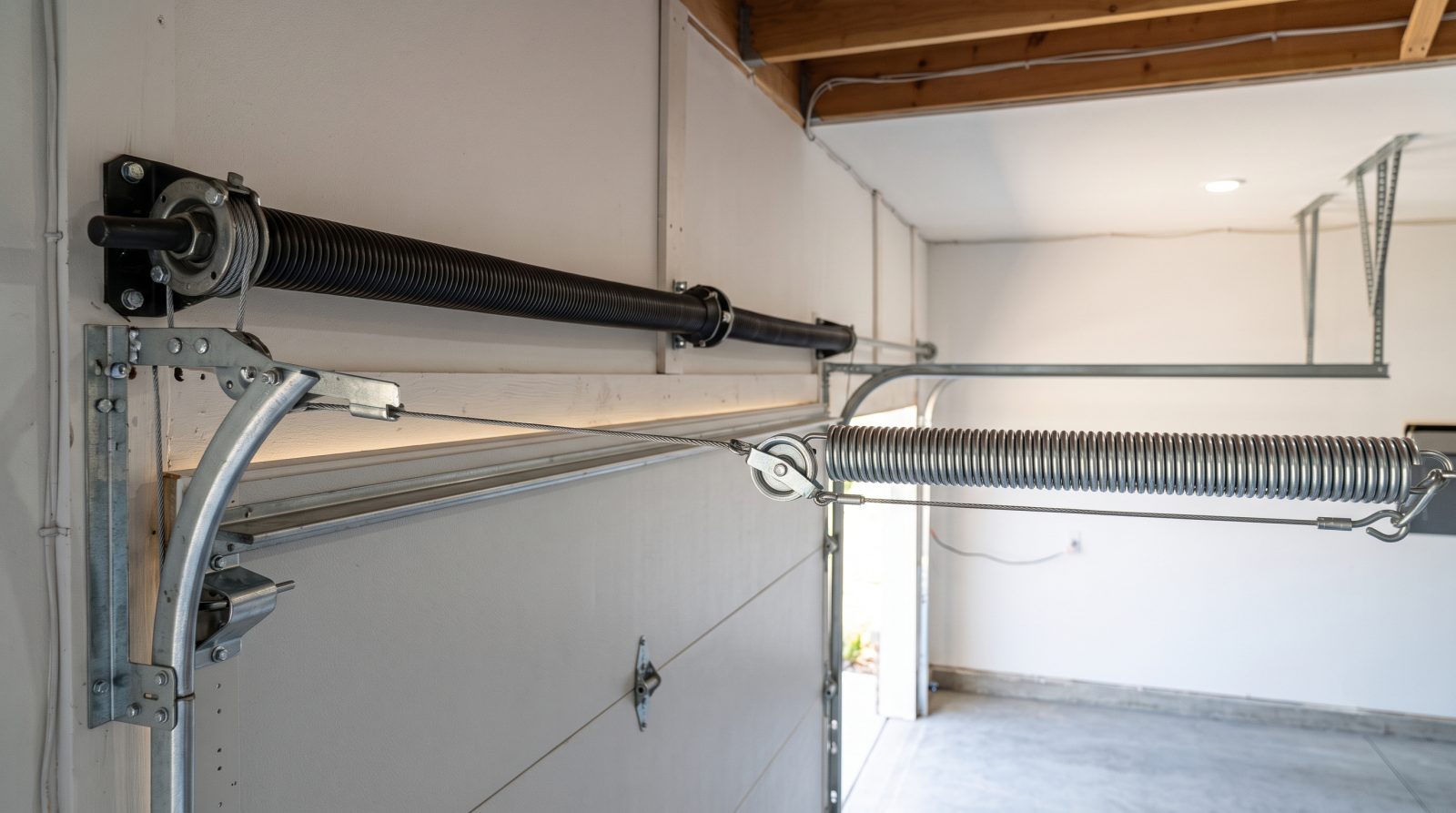
The Two Spring Systems: Torsion vs. Extension
Almost every residential garage door in the Bay Area uses one of two spring systems, and you can usually tell them apart in a few seconds by where the springs sit. Torsion springs are mounted on a metal shaft running horizontally along the wall directly above the closed door, parallel to the top edge. Extension springs run along the horizontal tracks on each side of the door, stretching from the back of the track toward the front as the door closes. Both store the energy needed to counterbalance the door's weight, but they do it in fundamentally different ways.
A torsion spring works by twisting. When the door lowers, cables wound around drums on the shaft turn the spring and load it with torque; when you lift the door, that stored torque unwinds and turns the drums to wind the cables back up, raising the door. Because the force is delivered through a controlled, rotating shaft, torsion systems lift more smoothly, balance the door more precisely, and put less shock on the door and opener. They are the system most pros recommend for anything but the lightest single-car doors.
An extension spring works by stretching. As the door closes, the spring extends and stores energy in tension; as the door opens, it contracts and pulls the door up. Extension systems are simpler and were common on older and lighter doors, but they exert their force from the sides rather than a central shaft, which can let a door rack or hang slightly unevenly over time. Critically, a stretched extension spring is under tremendous tension along its whole length, which is why safety cables (covered below) matter so much on this design.
How They Work Day to Day, and Why Springs Wear Out
Springs are rated in cycles, not years. One cycle is a single open-and-close. A typical builder-grade spring is rated for roughly 10,000 cycles, while higher-cycle springs are commonly available in 20,000- and 30,000-plus-cycle versions. The math matters more than most homeowners realize. A household that opens the door four times a day racks up close to 1,500 cycles a year, so a 10,000-cycle spring lands somewhere in the six-to-eight-year range, while a high-cycle spring on the same door can run well over a decade.
Bay Area usage patterns push that number around. If your garage is the main entrance to the house, the family comes and goes for school runs, BART or ferry commutes, and weekend trips, you may be hitting eight, ten, or more cycles a day, which quietly burns through spring life faster than the rating suggests. Conversely, a detached garage used mostly for storage may outlive its spring rating.
Climate plays a smaller but real role here than in harsher regions. The Bay Area's mild, marine-influenced weather is gentle on springs compared to freeze-thaw climates, but coastal moisture and salt air, especially closer to the bay and ocean, accelerate corrosion. Rust is a spring's enemy: it pits the steel, concentrates stress, and shortens life. Galvanized or coated springs and a light annual lubrication of the coils noticeably slow that down.
- Cycle ratings to know: ~10,000 (standard), ~20,000, and 30,000+ (high-cycle) open-and-close cycles
- Rough lifespan math: roughly cycles divided by your daily uses, divided by 365
- Heavy-use clue: if the garage is your main door in and out of the house, plan for the higher end of usage
- Corrosion accelerators: coastal salt air, moisture, and an unlubricated, neglected spring
Warning Signs Your Spring Is Failing
Springs rarely fail without warning, but the warnings are easy to miss until the door won't move. The single most common and unmistakable sign is a loud bang from the garage, often mistaken for something falling or even a gunshot. That sound is a torsion or extension spring snapping under load, and once it does the door will usually feel extremely heavy or simply refuse to open.
Before a full break, watch for the door opening unevenly or hanging crooked, jerking or stuttering on the way up, or feeling much heavier than it used to. A telling test, only if you can do it safely with the opener fully disconnected, is to lift the door manually to about waist height and let go: a properly balanced door stays roughly in place, while a door with a weak or broken spring slams down or shoots up. You may also see a visible gap in a torsion spring's coils, or a stretched, sagging extension spring that no longer contracts fully.
One detail homeowners often get wrong: when the door won't open and the opener just hums or clicks, the opener is frequently blamed first. In reality a healthy opener simply can't lift a door whose spring has failed, because it was never designed to carry the door's full weight on its own. Replacing or reprogramming the opener won't fix a broken spring.
- A sudden loud bang or pop from the garage, then a door that won't lift
- Door feels noticeably heavier, or the opener strains, hums, or stops partway
- Door opens crooked, jerks, or one side lags the other
- Visible gap in a torsion coil, or a sagging, fully stretched extension spring
- The manual balance test fails: the door won't hold position at waist height
Single vs. Dual Springs, Sizing, and Matching the System
On torsion setups, a door may run on a single spring or a pair. Two springs are the preferred configuration on most double-car and heavier doors for a simple reason: if one breaks, the second can often still partially counterbalance the door, which reduces the chance of a dangerous slam and protects the opener from strain. Many pros recommend replacing torsion springs in matched pairs even when only one has broken, because the surviving spring is the same age and usually close behind on cycle life. Replacing just one often means a second service call within months.
Correct sizing is what makes a spring system safe and quiet, and it is not a guess. A torsion spring is specified by wire diameter, inside diameter, and overall length; an extension spring is rated to the door's weight. These are matched to your specific door's weight and height, which is why an accurate replacement starts with weighing or carefully assessing the actual door, not just eyeballing it. Bay Area homes span everything from lightweight aluminum-and-glass contemporary doors in newer builds to heavy solid-wood doors on older Craftsman and Mediterranean-style houses, and a spring sized for one would be wrong for the other.
If your home currently runs extension springs and you're already replacing them, it's worth asking whether a conversion to a torsion system makes sense. Torsion generally gives smoother operation, better balance, longer life, and a cleaner safety profile. It isn't always necessary or possible depending on headroom above the door, but it's a reasonable upgrade to discuss while the system is apart.
- Dual torsion springs add a safety and balance margin on heavier and double doors
- Replacing torsion springs in pairs avoids a near-term second failure and service call
- Torsion sizing depends on wire diameter, inside diameter, and length, matched to door weight
- Heavy solid-wood doors and light aluminum-glass doors need very different springs
- Extension-to-torsion conversion is a common upgrade where headroom allows
Why Spring Work Is a Pro Job: Safety and Tools
Garage door springs hold an enormous amount of stored energy, and that is exactly what makes them dangerous to service without the right training and tools. A loaded torsion spring is under hundreds of pounds of torque; if it lets go while being adjusted by hand or with the wrong tool, it can break fingers, hands, and wrists or whip a tool across the garage. This is one of the few home repairs where the standard advice from the industry is unambiguous: leave torsion spring work to a trained technician.
Torsion springs are wound and unwound with properly sized winding bars inserted into the spring cone, with the door secured and the opener disconnected, in a specific sequence. Substituting screwdrivers or undersized bars is a classic cause of serious injury. The shaft, drums, and cables all have to be handled in the right order and tensioned correctly, or the door will be unbalanced and unsafe even if it appears to work.
Extension springs carry their own specific hazard. Because they are under tension along their entire length, a snapped extension spring can launch across the garage. That is the whole reason for safety cables, the steel cable threaded through the center of each extension spring and anchored at both ends. If your door has extension springs without safety cables, that is a genuine safety gap worth correcting whether or not you're replacing the spring itself.
- Loaded springs store enough energy to cause serious hand, wrist, and head injuries
- Torsion work requires correctly sized winding bars, a secured door, and a set sequence
- Extension springs need safety cables to contain a break; missing cables are a real hazard
- Improvised tools and DIY torsion adjustment are a leading cause of garage-door injuries
- A correctly serviced door is rebalanced and tested, not just made to move
Typical Cost Ranges in the Bay Area (Estimates)
Spring replacement pricing varies with the type and number of springs, the cycle rating you choose, the door's weight and size, and the labor to do the job correctly, so treat the following as typical industry ranges rather than a quote. As estimates that vary by region, door, material, and scope, a single torsion spring replacement commonly falls in roughly the $200 to $350 range, while replacing a matched pair often lands in the $300 to $500 range. Extension spring replacement is frequently a bit lower, commonly in the $150 to $300 range depending on the door and whether safety cables are added.
Several choices move you within those ranges. Opting for higher-cycle springs costs a little more up front but can substantially extend lifespan, which often pays off on a door used many times a day. Heavier solid-wood and oversized doors require larger, stronger springs and more careful balancing, nudging cost upward. Adding safety cables, replacing worn lift cables at the same time, or correcting a previously mis-sized system are common add-ons that are usually worth doing while the system is already apart.
Because we're a mobile service, we bring the parts and tools to your driveway anywhere across the Bay Area and size the spring to your actual door on site, so the door is left balanced and tested rather than just operational. If your spring just snapped and your car is stuck inside, call for a free quote and we'll walk you through your options and what your specific door needs.
- Single torsion spring: roughly $200 to $350 (estimate, varies)
- Matched pair of torsion springs: roughly $300 to $500 (estimate, varies)
- Extension spring replacement: roughly $150 to $300 (estimate, varies)
- Higher-cycle springs cost more up front but extend lifespan on high-use doors
- Common worthwhile add-ons: safety cables and replacing worn lift cables at the same time