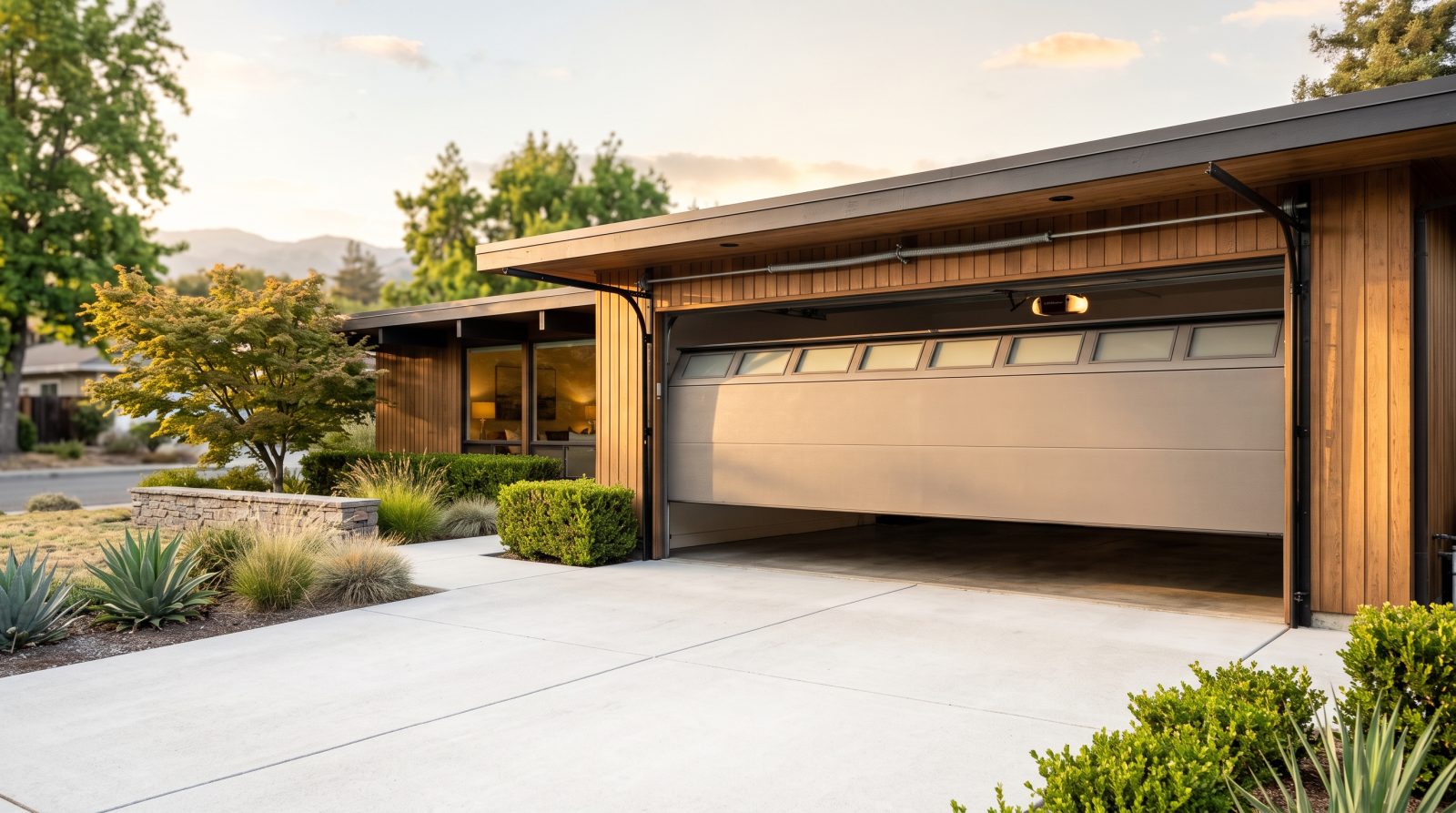
Garage door repair built for Sunnyvale homes
Sunnyvale's housing is unusually varied for a city its size, and garage doors fail differently across it. The mid-century core, the Eichler tracts around Greenmeadow's edge, the ranch homes in Birdland and Cherry Chase, and the dense newer townhomes near downtown each present their own quirks. A 1955 Eichler often still wears its original or first-replacement door behind a carport-style opening with a flat roofline, where there's little overhead clearance and the framing is light. A 1990s two-car ranch garage may run a builder-grade chain opener that's simply worn out. The newer attached townhome garages off Mathilda and near the Caltrain corridor tend to have higher-cycle doors and smart openers that throw error codes more than they break mechanically.
Because we're mobile, we adapt the repair to your actual door rather than to whatever a storefront happens to stock. We arrive with common spring sizes, cables, rollers, hinges, opener components, and the tools to measure and order anything door-specific. Most homeowners just want the door working again before the next school run or commute, and the large majority of calls are resolved in a single visit.
- Torsion and extension spring replacement (the most common single failure)
- Snapped or frayed lift cables and off-track doors realigned and re-tensioned
- Worn rollers, hinges, and bearings replaced to stop grinding and binding
- Opener repair and replacement, including modern smart and Wi-Fi units
- Bent or dented panel repair, and full panel or section replacement where needed
- Safety sensor alignment and force-setting adjustment so the door reverses correctly
The repairs Sunnyvale homeowners call about most
Broken springs are the number-one call, and for good reason. Most residential torsion springs are rated for a finite number of open-close cycles, and a household that uses the garage as its main entrance can burn through that life in a handful of years. When a spring snaps you'll often hear a loud bang from the garage, then find the door either stuck shut or alarmingly heavy to lift by hand. This is not a DIY job: torsion springs hold enormous stored energy and require winding bars and proper technique to service safely. We replace springs in matched pairs where appropriate and set the correct tension for your door's weight, which is the single biggest factor in how long the next set lasts.
The second cluster of calls is openers and the small parts around them. A door that reverses halfway, won't close at night, or only works intermittently is frequently a sensor or force-adjustment issue rather than a dead motor, an important distinction because the fix can be minor. Worn rollers and dry hinges produce the grinding and shuddering that neighbors in close-built Sunnyvale lots tend to notice. And off-track doors, often the aftermath of a backed-into door or a failed cable, need to be carefully reseated rather than forced, since forcing them bends track and turns a modest repair into a larger one.
- Loud bang then a stuck or very heavy door: almost always a broken spring
- Door reverses before closing: usually misaligned safety sensors or force settings
- Grinding, squealing, or shuddering travel: worn rollers, dry hinges, or bad bearings
- Opener runs but door doesn't move: stripped trolley gear or disconnected carriage
- Door crooked or jammed in the track: a snapped cable or off-track roller
New garage door installation and replacement
When a door is beyond economical repair, or when you're simply ready for a better-looking, quieter, better-insulated one, we handle installation as a we-come-to-you service. We measure your opening on site, account for the headroom and side-room realities common in older Sunnyvale garages, and help you choose a door that fits both the structure and the look of the street. For Eichler and mid-century ranch homes, that often means a clean flush or modern-grooved steel panel that respects the architecture rather than fighting it. For two-car and townhome garages, insulated sectional steel doors are usually the practical sweet spot for durability and noise.
Insulation deserves real thought here. Many Sunnyvale garages are attached and increasingly used as gyms, offices, or laundry-plus-storage rooms. An insulated door meaningfully steadies the temperature in those spaces and cuts the rattle of an opener cycling early in the morning. We'll talk through panel material, window options, R-value, and opener pairing honestly, including when your existing opener is fine to keep and when replacing both together is the smarter spend.
- On-site measuring sized to your actual headroom and side-room
- Insulated steel sectional doors for quieter, more temperature-stable garages
- Flush and modern-grooved styles suited to Eichler and ranch architecture
- Window, color, and hardware options matched to your home and street
- Optional new opener paired to the door, with smart/Wi-Fi units available
- Old door and hardware hauled away as part of the install
Why Sunnyvale's climate and traffic shape garage door wear
Sunnyvale's mild Mediterranean climate is gentle on doors compared with snow country, but it has its own slow hazards. The marine layer that rolls in off the Bay near Moffett carries moisture and a faint salt edge that, over years, encourages surface rust on springs, cables, hinges, and fasteners, especially on north-facing garages that stay damp longer. Long dry summers then bake out the factory lubricant, so the metal-on-metal wear that produces grinding and premature roller failure tends to accelerate if a door is never re-lubricated. A twice-yearly clean-and-lube of rollers, hinges, springs, and the opener rail is the cheapest insurance against most of the repairs above.
Usage patterns matter just as much as weather. Silicon Valley commutes mean many Sunnyvale garages cycle multiple times every weekday, and homes where the garage is the main door rack up cycles fast. High cycle counts shorten spring life and loosen hardware, so the door that gets used hardest is the one to keep an eye on. If yours is noticeably louder than it was a year ago, or hesitates on the way up, that's the early-warning stage where a small adjustment prevents a roadside-style emergency in your own driveway.
- Coastal moisture and salt air promote rust on springs, cables, and fasteners
- Dry summers dry out lubricant, accelerating roller and hinge wear
- High daily cycle counts from commuting shorten spring and hardware life
- Twice-yearly lubrication and a tune-up prevent the majority of breakdowns
- Rising noise or hesitation is the cue to book service before a full failure
What garage door repairs typically cost
Pricing for garage door work varies with the part, the door's size and weight, the material, and the scope of the job, so the figures below are typical industry ranges offered as estimates, not fixed quotes. A spring replacement is generally a moderate, well-defined cost and is usually best done in pairs so the second spring doesn't fail weeks later. Opener repairs range widely depending on whether it's a sensor or adjustment versus a worn drive mechanism, while a full opener replacement is a larger but predictable line item. Roller, hinge, and cable work tends to sit at the lower end unless the door has run off-track and bent its hardware. A complete new-door installation is the largest category and depends heavily on material, insulation, windows, and whether a new opener is included.
The honest way to price any of this is to see the door. We give you a clear estimate before work begins, explain what's failing and why, and tell you plainly when a repair makes more sense than a replacement, or the reverse. If your opener or springs have real life left, we'll say so rather than recommend parts your door doesn't need. Call us for a free quote and we'll come to you across Sunnyvale and the wider Bay Area.
- Costs vary by door size, weight, material, and job scope; ranges below are estimates
- Springs: a moderate, defined cost, usually replaced in matched pairs
- Opener repair: wide range; a sensor/adjustment fix costs far less than a motor
- Opener replacement: a larger but predictable single line item
- Rollers, hinges, and cables: typically lower cost unless the door is off-track
- New door installation: the largest category, driven by material and insulation