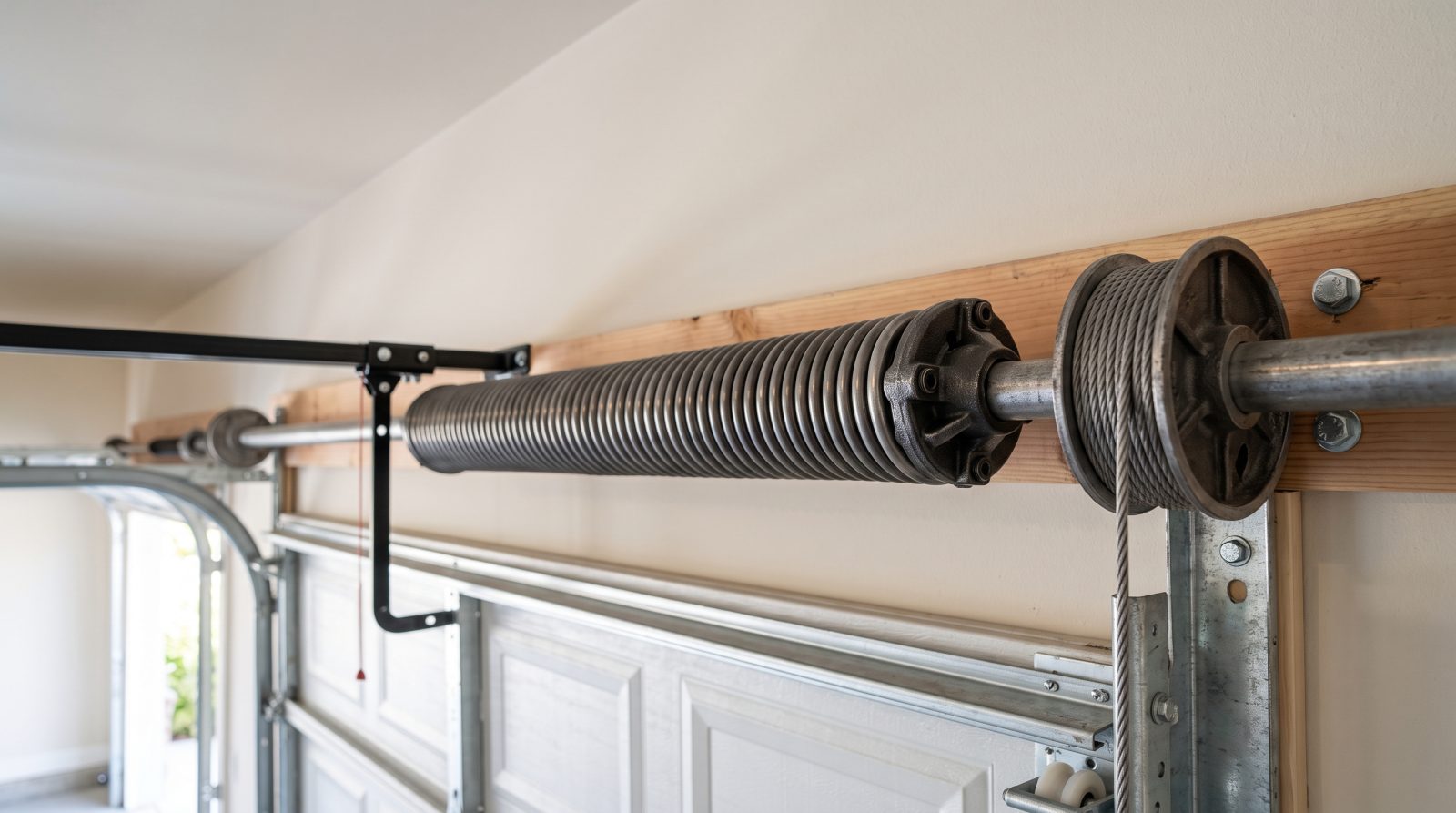
How garage door springs actually work (torsion vs. extension)
Your garage door is heavy often 130 to 350+ pounds for a double door and the springs, not the opener, do the real lifting. The electric opener is essentially just a guide and a motor for the last bit of force; the springs counterbalance almost the entire weight of the door so it feels nearly weightless. That is why a door with a broken spring can feel like it weighs a ton and why the opener struggles, strains, or refuses to lift it at all.
There are two main systems, and which one you have changes the repair completely. Torsion springs mount horizontally on a metal shaft above the door opening and store energy by twisting. They are the more modern, durable, and balanced design, and they are common on the heavier doors and newer construction we see throughout the Bay Area. Extension springs run along the horizontal tracks on each side of the door and stretch and contract as the door moves. They are older and more common on lighter single-car doors in many established neighborhoods.
Knowing which system you have matters because torsion and extension springs fail differently, are sized differently, and require different replacement parts and procedures. When we arrive, the first thing we do is identify your exact system, measure the spring's wire size, inside diameter, and length, and match a replacement rated for your specific door weight and cycle life.
Why garage door springs break and the warning signs
Springs do not last forever they are wear parts with a finite lifespan measured in cycles (one cycle is one full open-and-close). A standard spring is often rated for roughly 10,000 cycles, which for a busy household opening the door multiple times a day can translate to only a handful of years. Higher cycle-rated springs exist and last considerably longer, and choosing the right rating is one of the most useful upgrades we can offer during a repair.
Several Bay Area realities accelerate spring wear. Homes near the coast and bay in areas like the Sunset, the Richmond, Pacifica, Alameda, and parts of the Peninsula deal with salt-laden marine air and persistent damp, which encourages rust at the coils; corroded steel fatigues and snaps far sooner. Daily temperature swings, where a foggy 55-degree morning gives way to a warm afternoon, make the metal expand and contract repeatedly. Heavy use, deferred maintenance, and improperly balanced doors also shorten spring life dramatically.
- A loud bang from the garage often the single clearest sign a spring has snapped
- The door will not open, or the opener hums and strains but the door barely moves
- A visible gap in the torsion spring above the door, or a stretched/dangling extension spring
- The door feels extremely heavy when you try to lift it by hand
- The door opens crookedly, jerks, or slams down faster than normal
- Loud grinding, squeaking, or popping during operation
Why DIY spring replacement is genuinely dangerous
We want to be direct about this: garage door spring replacement is one of the few home repairs we strongly urge people not to attempt themselves. A torsion spring under tension stores an enormous amount of energy. If it slips or releases while being wound or unwound without the correct winding bars and technique, it can cause severe hand, wrist, and facial injuries. These injuries are serious and entirely preventable.
Beyond the immediate tension hazard, there are subtler risks. Installing a spring with the wrong wire size or length leaves the door unbalanced, which silently overworks the opener and burns out its motor and gears, turning a spring problem into a much larger bill. Mismatched or single-spring setups on a heavy double door wear out fast and put the whole system out of balance. Cable and drum work that accompanies spring jobs is equally unforgiving the cables are also under load.
A proper repair means using the correct winding bars, vise grips, and replacement parts, following a controlled tensioning procedure, and verifying the door's balance before the job is finished. It is faster, safer, and almost always more cost-effective than buying parts online and risking injury or a damaged opener.
What a proper spring repair looks like and what it typically costs
When you call us out, the visit is methodical rather than rushed. We secure the door, release tension safely, and inspect the entire counterbalance system not just the broken spring. Springs rarely fail in isolation: worn cables, frayed lift cables, grooved drums, and a dry, dirty track often contributed to the failure, and replacing only the spring without addressing those leaves you with another breakdown soon.
On most doors we recommend replacing springs in pairs even when only one has broken. The springs share the same age and cycle count, so if one has reached the end of its life the other is usually close behind. Replacing both at once means a balanced door, a single service visit, and far less chance of a repeat failure within months. We finish by re-tensioning, lubricating, cycling the door several times, and checking that it stays put halfway open the simple test that confirms the door is properly balanced.
On cost, spring repair pricing varies with the type of spring, the door's size and weight, the cycle rating you choose, and whether cables or other parts also need attention. As a general guide, professional torsion spring replacement commonly falls in the rough range of a few hundred dollars for parts and labor, with extension spring jobs sometimes lower; these are typical industry estimates only, not a quote, and your exact price depends on your specific door. We will always assess your door first and give you a clear estimate before any work begins.
Why Bay Area homeowners choose a mobile spring repair service
Because we are fully mobile, there is no driving a broken door anywhere and no waiting on a storefront's hours. We come to your home or business, whether you are in a San Francisco row house, a Peninsula ranch home, an Oakland or Berkeley craftsman, or a newer San Jose or Fremont build, and complete the repair on-site in your driveway. For a problem that can trap your car inside the garage, that responsiveness genuinely matters.
We bring common torsion and extension springs, cables, and hardware with us so most repairs are completed in a single visit, often the same day. We work on residential doors and light commercial overhead doors alike, and we are happy to talk through higher-cycle spring upgrades, opener health, and simple maintenance that will extend the life of your next set of springs.
If you have heard a bang, found your door stuck shut, or noticed any of the warning signs above, the safest move is to stop using the door and stop forcing the opener, since running it against a dead spring can damage the motor. Leave the door alone and call for a free quote we will get you a safe, balanced, properly repaired door without the risk of doing it yourself.