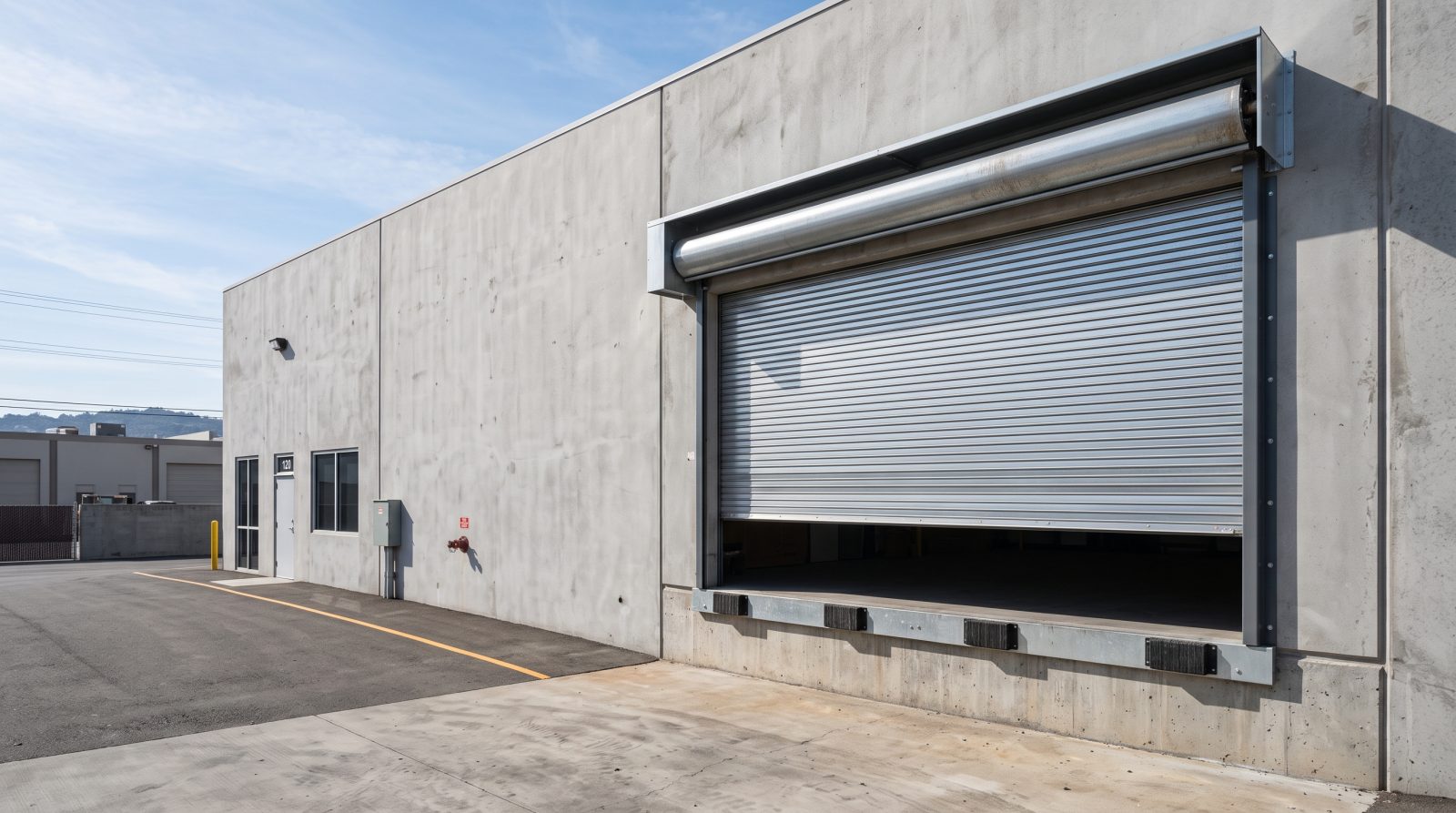
Commercial doors are a different animal than residential
A two-car garage door at a home might cycle four to six times a day. A commercial door at a busy Bay Area distribution dock, body shop, or food-service receiving bay can cycle that many times in an hour. That single difference — duty cycle — changes everything about how the door is built, how it fails, and how it should be maintained. Commercial systems use heavier-gauge steel, larger torsion springs rated for far more cycles, commercial-grade openers (often jackshaft or hoist-style rather than the chain-drive units common in homes), and safety hardware sized for the weight and speed of a much larger door.
Choosing the right door type matters as much as choosing the right contractor. Rolling steel doors coil into a compact barrel above the opening, which makes them ideal where ceiling and side-room are tight — narrow San Francisco storefronts, retrofitted industrial bays, and parking structures. Sectional commercial doors run on horizontal tracks like a large residential door and are the workhorse of warehouses and loading docks, where insulation, light, and the ability to add vision panels matter. Each has its place, and putting the wrong one in an opening is an expensive mistake that no amount of later repair fully corrects.
- Rolling steel service doors — compact coil design for tight headroom, security shutters, and high-traffic openings
- Insulated sectional doors — for warehouses, docks, and climate-sensitive spaces that need thermal control
- High-cycle torsion springs — rated for the thousands of cycles a busy commercial opening sees
- Commercial openers — jackshaft, hoist, and trolley operators sized to door weight and frequency of use
- Fire-rated and counter doors — for code-driven openings and service-window applications
What actually breaks on a heavy-use commercial door
The failures we see most on Bay Area commercial doors are almost always tied to wear from volume. Torsion springs are the single most common culprit: every full open-and-close is one cycle, and springs are engineered to a finite cycle count. A spring that would last a decade on a home door can wear out in a year or two on a door that opens hundreds of times daily. When a spring breaks, the door becomes dangerously heavy or refuses to move at all — and on a commercial system, the stored energy in those springs makes this a job for trained hands, not staff.
Beyond springs, the points of failure follow the traffic. Rollers, bearings, and hinges grind down under constant load. Track gets bent by forklifts, pallet jacks, and the occasional misjudged delivery truck. On rolling steel doors, the curtain slats can bend or jump the guides after an impact, and the bottom bar and astragal take a beating. Openers fail from thermal overload when they are undersized for the duty, and photo-eye sensors and reversing edges — the safety devices that stop a door from closing on a person, vehicle, or product — drift out of alignment or get knocked loose in a busy environment. Each of these is repairable, but a door limping along on worn parts is both a safety liability and a productivity drain.
- Broken or fatigued torsion springs from high daily cycle counts
- Worn rollers, bearings, hinges, and shaft components
- Bent track or damaged curtain slats from forklift and vehicle impact
- Opener burnout on units undersized for the door's weight and duty
- Misaligned or damaged photo-eyes, reversing edges, and safety sensors
- Failed bottom seals and weatherstripping letting in Bay Area damp and drafts
Bay Area realities that shape commercial door wear
The Bay Area is not one climate, and your door feels the difference. Facilities near the bay and the coast — think the industrial corridors of Oakland, Richmond, South San Francisco, and the Peninsula flats — live in salt-laden marine air and persistent fog. That moisture accelerates rust on steel curtains, springs, fasteners, and tracks, and it punishes any unprotected metal at the bottom of a door where condensation collects. Inland operations in the East Bay and South Bay swing the other way, with hot dry summers that bake lubricants out of bearings and tracks, leaving them to run dry and wear fast.
Then there is how Bay Area businesses use space. Tight urban lots and older buildings mean many doors were retrofitted into openings they were never designed for, with minimal headroom and side-room — exactly the conditions that make rolling steel attractive and that make sloppy installation fail early. Seismic considerations, strict fire and life-safety codes, and the simple fact that real estate is too valuable to leave a dock down all add up to one conclusion: commercial doors here need to be specified correctly for their environment and serviced on a schedule, not run until they break. A door that is well-matched to a foggy Oakland dock is a different build than one for a hot Livermore warehouse.
How our mobile commercial service works
We are a mobile service, which for a commercial client means the shop comes to your facility — there is no need to take a door off-site or shuttle anything anywhere. We assess the full opening, not just the part that failed, because a broken spring on a door with worn bearings and bent track is a temporary fix waiting to fail again. After diagnosing the system, we walk you through what is wrong, what is worth repairing versus replacing, and the realistic options at different price points so you can make a call that fits your operation and budget.
For repairs, we carry the common high-wear commercial parts so many issues can be handled in a single visit, and we work to minimize downtime on the openings your business runs on. For new installations and replacements, we help you spec the right door type, insulation value, opener class, and safety package for how the opening is actually used — then install it properly tracked, balanced, and tuned. We also set up preventive maintenance, because the cheapest commercial door problem is the one caught during a scheduled check rather than the one that strands a delivery truck at the dock. Whether you run one bay or a row of them, we aim to be the call that gets your opening working and keeps it that way.
- On-site diagnosis of the whole door system, not just the visible failure
- Same-day and fast response for down doors that halt operations
- Repair, part replacement, full installation, and replacement of commercial systems
- Spec guidance on door type, insulation, opener class, and safety hardware
- Preventive maintenance plans to catch wear before it becomes downtime
Why preventive maintenance pays for itself
Commercial door maintenance is one of the few facility expenses that reliably costs less than the problem it prevents. A scheduled service visit checks and adjusts spring tension, lubricates and inspects rollers and bearings, tests the safety reversal and photo-eyes, tightens hardware loosened by constant vibration, and catches a bent track or a fraying cable before it becomes a sudden, total failure. The math is simple: an hour of planned service is cheaper than an emergency call, a stalled dock, and the lost throughput of a door that goes down mid-shift.
There is also a safety and liability dimension that businesses cannot ignore. Commercial doors are heavy, fast, and powered, and their safety devices exist to protect employees, customers, vehicles, and inventory. A reversing edge or photo-eye that has drifted out of spec is a hazard the moment someone walks under a closing door. Regular service keeps those systems verified and working, supports compliance for code-driven and fire-rated openings, and gives you documentation that the equipment has been maintained. For any facility where a door is part of daily operations, that peace of mind is worth far more than the service costs.