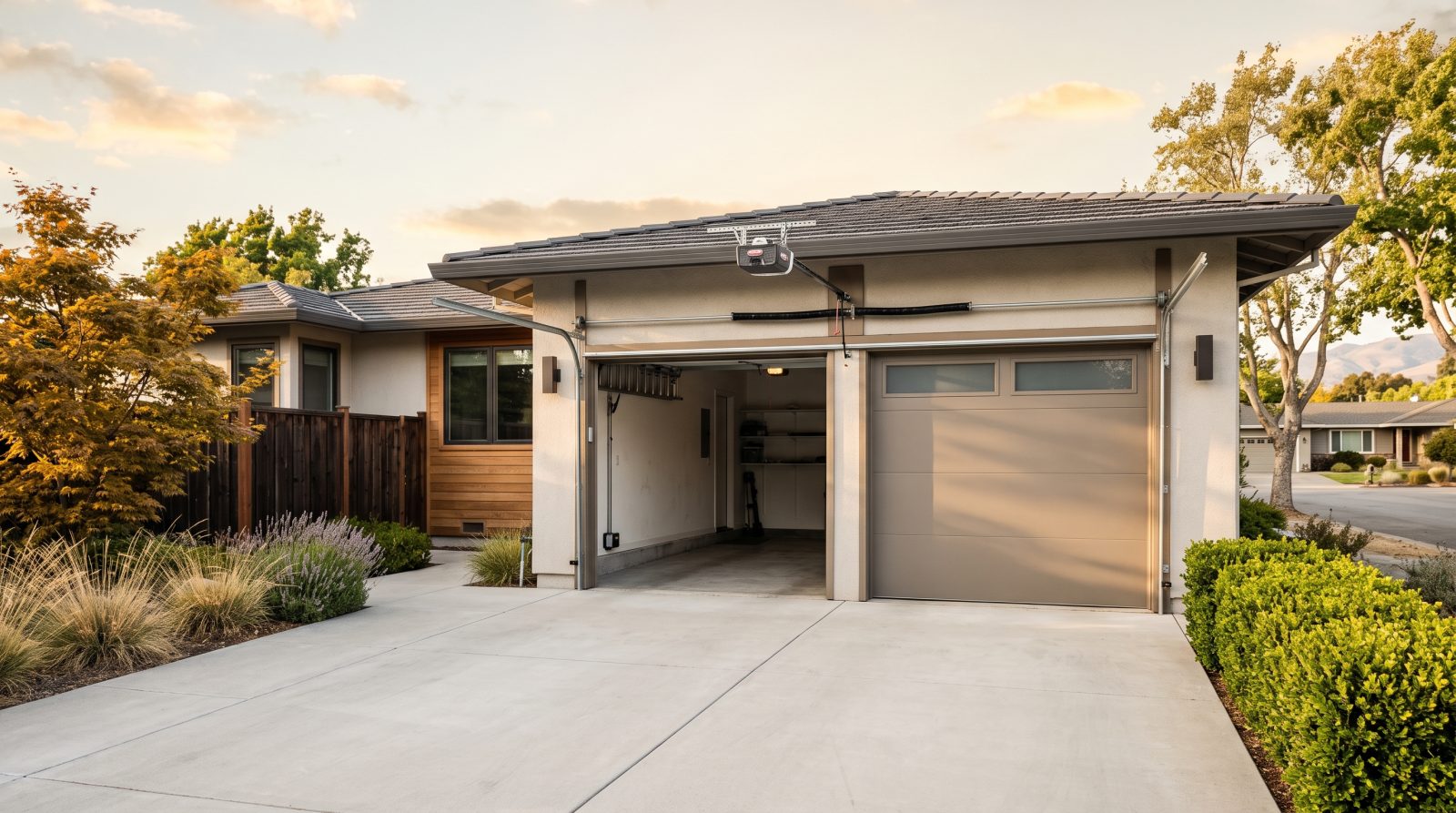
Garage Door Repair Across Redwood City's Neighborhoods
Redwood City covers a lot of ground and a lot of housing eras, and each one tends to throw a slightly different garage door problem at us. We work the whole city as a mobile service, so it doesn't matter whether your driveway is on the flats or up a hill — we load the van and come to you.
The older neighborhoods around Mt. Carmel and the Roosevelt area are full of mid-century homes and classic ranch houses, many with their original wood doors or first-generation steel replacements. These doors are heavy, the hardware is often decades old, and the springs are frequently near the end of their service life. On the other end of town, the newer townhome and condo developments near downtown, Franklin Street, and the Theatre District lean on modern sectional steel doors with belt-drive openers — quieter, but with electronics and safety sensors that need occasional attention.
Up in the hills toward Emerald Hills, Farm Hill, and the Edgewood area, we see steeper driveways and homes where the garage sits below the living space. Door balance matters even more on a slope, because an unbalanced door fights gravity differently than it does on flat ground, and a worn opener will struggle. Out toward the bay — Redwood Shores, the Seaport industrial corridor, and the marina-side properties near Bair Island — salt-laden air becomes the dominant factor, and we'll cover that below.
- Downtown, Centennial, and the Caltrain-adjacent blocks: modern sectional doors, opener and sensor work, tight side-yard access
- Mt. Carmel, Roosevelt, and the older flats: aging springs, original wood and early-steel doors, worn rollers and hinges
- Emerald Hills, Farm Hill, Edgewood: sloped driveways where door balance and opener strength are critical
- Redwood Shores and the Seaport corridor: salt-air corrosion on springs, cables, hardware, and bottom panels
The Repairs We Handle Most in Redwood City
Most garage door failures come down to a handful of parts working under heavy, repeated load. A typical residential door weighs well over a hundred pounds, and the spring system is what carries that weight so the opener (or your arm) only has to nudge it. When something in that system wears out, the whole door feels it.
Broken torsion springs are the single most common emergency call we get. A spring is rated for a set number of cycles — roughly 10,000 on a standard spring, which for a busy household can be only a handful of years — and when it snaps you'll usually hear a loud bang and then find the door too heavy to lift or stuck partway. This is not a DIY repair: torsion springs hold tremendous stored energy and require proper winding bars and technique to change safely.
Beyond springs, we replace frayed or snapped cables, worn rollers that make the door grind and shudder, bent or misaligned tracks, and tired openers. Misaligned or dirty safety sensors are a frequent and easy fix — if your door starts to close and then reverses for no reason, the photo-eye sensors near the floor are usually the culprit. We also realign doors that have jumped off-track, often after a car bump or a roller failure, and we replace cracked or dented panels when only part of the door is damaged.
- Broken torsion and extension spring replacement (done in matched pairs for even balance)
- Snapped or frayed lift cables and drums
- Worn rollers, hinges, bearings, and noisy hardware
- Off-track doors realigned and re-tensioned
- Opener repair or replacement — motors, gears, logic boards, remotes, and keypads
- Safety sensor alignment, photo-eye cleaning, and travel-limit adjustment
- Section and panel replacement, weather seals, and bottom astragal gaskets
How the Bay Climate Affects Redwood City Doors
Redwood City's microclimate is gentler than the foggy coast — the city's old slogan, 'Climate Best by Government Test,' wasn't entirely a joke — but the conditions here still wear on a garage door in specific ways. The big factors are humidity swings, salt air near the bay, and the daily temperature roll between cool, damp mornings and warm afternoons.
If your home is in Redwood Shores or anywhere near the Seaport and the marina, salt-laden air is the quiet enemy. It accelerates rust on torsion springs, cables, hinges, and the steel bottom section of the door. Salt corrosion shortens spring life and seizes rollers and bearings faster than the same parts would wear inland. On bay-adjacent homes we recommend galvanized or coated hardware and a regular wipe-down and lubrication schedule to slow the corrosion.
Inland and in the hills, the bigger issues are moisture and temperature cycling. Damp morning air combined with afternoon warmth can swell and warp older wood doors, throwing off their fit and balance, while metal parts expand and contract daily. That constant movement loosens fasteners, dries out lubricant, and makes a door progressively noisier. None of this is dramatic on its own, but over years it's why an opener that once ran smoothly starts straining — the door has slowly fallen out of balance and the motor is picking up the slack.
- Bay-adjacent homes (Redwood Shores, Seaport, Bair Island): prioritize rust-resistant hardware and frequent lubrication
- Older wood doors inland: watch for swelling, warping, and a door that fits unevenly
- Daily temperature cycling loosens hardware and dries out lubricant over time
- A door that's slowly gone out of balance is the most common hidden cause of opener strain
New Garage Door & Opener Installation
Sometimes a repair isn't the right call — when a door is badly rusted, multiple panels are damaged, or the design is decades out of date, a new door is often the better long-term value and a meaningful upgrade to your home's curb appeal and energy efficiency. As a mobile installer, we measure on-site, walk you through realistic options for your specific opening, and handle the full swap.
For Redwood City homes, the choice usually comes down to material and insulation. Insulated steel doors are the workhorse — durable, low-maintenance, and good at moderating the garage temperature, which matters if your garage doubles as a workshop, gym, or laundry space. Aluminum-and-glass contemporary doors suit a lot of the modern downtown and Redwood Shores builds and let in light. Wood and wood-look composite doors fit the character of older Mt. Carmel and Emerald Hills homes, with composite giving you the warmth of wood without the bay-humidity warping. Near the water, we steer customers toward materials and hardware that stand up to salt air.
On the opener side, modern belt-drive units are dramatically quieter than the old chain-drive motors — a real benefit when bedrooms sit above or beside the garage, as they do in many local townhomes. Today's openers also add genuine safety and convenience: smartphone control, battery backup so the door still works in a power outage, rolling-code security, and auto-reverse safety systems. We make sure every install is properly balanced first, because even the best opener will fail early if it's dragging a poorly balanced door.
- Insulated steel: the durable, low-maintenance default for most Bay Area homes
- Aluminum and glass: a clean, modern look for contemporary downtown and Redwood Shores builds
- Wood and composite: character matches for older neighborhoods, with composite resisting humidity
- Belt-drive openers: quiet operation for homes with rooms over or beside the garage
- Battery backup keeps your door working during a power outage
- Every installation is balanced and safety-tested before we leave
What Garage Door Repairs Typically Cost
Pricing is one of the first things people want to understand, so here are typical industry ranges to give you a realistic sense of scale. Treat these as estimates only — real cost depends on your door's size and weight, the part and material, how the door is built, and the full scope of what we find on-site. We always confirm the price with you before any work begins, and a quote is always free.
Spring replacement is the most common job and a good example of why pricing varies: a single standard residential spring is one range, but we almost always replace springs in matched pairs so the door stays balanced, and heavier or oversized doors use larger, costlier springs. Smaller fixes like roller replacement, sensor realignment, or a new remote are toward the lower end. A full opener replacement or a complete new door install sits at the higher end because it involves more parts and more labor — but it's also a much longer-lasting result.
One honest money-saving point: maintenance is far cheaper than emergency repair. A door caught early — lubricated, re-balanced, with worn rollers swapped before they fail — rarely becomes the midnight spring-snap that strands your car in the garage. If we ever think a repair is throwing good money after bad on a door near the end of its life, we'll tell you plainly and price out the replacement so you can compare.
- Spring replacement: a moderate range, typically done in pairs; heavier doors cost more
- Cable, roller, hinge, and sensor work: generally toward the lower end
- Opener repair vs. full opener replacement: repair is cheaper when the motor and board are sound
- New door installation: the highest range, varying widely by material, size, and insulation
- All ranges are estimates that vary by door, material, and scope; your free quote is the real number
Keeping Your Redwood City Garage Door Healthy
A garage door is the largest moving object in most homes and the one people think about least until it stops. A little routine attention goes a long way, especially in the Bay Area's humid, salt-touched air, and most of it you can do yourself in a few minutes a couple of times a year.
Start by listening and watching. A door should open and close smoothly, quietly, and evenly. Grinding, popping, or jerking means worn rollers, dry hardware, or a balance problem. To test balance, disconnect the opener (pull the manual release) and lift the door halfway by hand — a well-balanced door will hold roughly in place; if it slams down or shoots up, the springs need attention and you should stop using the opener until it's serviced. Keep the photo-eye sensors near the floor clean and aligned, and never disable the auto-reverse safety feature.
Lubricate the moving metal parts — rollers, hinges, springs, and bearings — with a proper garage door lubricant (not WD-40, which is a cleaner, not a lasting lube), and do it more often if you're near the bay. Keep the tracks clear of debris but don't over-grease them. If anything feels off, it's worth a professional look before a small wear issue becomes a stuck door. As your mobile service across the Bay Area, we're glad to come tune up a door, diagnose a noise, or quote a replacement — call for a free estimate and we'll come to you.
- Twice a year, lubricate rollers, hinges, springs, and bearings with a real garage door lubricant
- Test door balance with the opener disconnected — it should hold at the halfway point
- Wipe down and lubricate more often if you live near the bay or the Seaport
- Keep photo-eye sensors clean and aligned, and never disable auto-reverse
- Address grinding, popping, or jerking early — it's cheaper than an emergency