Typical Garage Door Repair Cost Ranges (At a Glance)
Most residential garage door repairs in the Bay Area fall somewhere between a modest service call and the cost of a high-end opener swap. The single biggest variable is which component failed. Springs, cables, rollers, and small hardware are relatively inexpensive parts but require skilled, safe installation. Openers, panels, and track replacement climb higher because the parts themselves cost more and the labor is more involved.
The ranges below reflect typical parts-plus-labor pricing seen across the industry for standard residential doors. They are estimates, not quotes — your actual price depends on door size and weight, single vs. double door, material, brand, and how badly worn or damaged the surrounding system is. Heavier doors (solid wood, insulated steel, or oversized double doors common on newer Bay Area homes) sit toward the upper end because they need stronger, costlier components.
- Torsion spring replacement: roughly $200–$450+ depending on door weight and whether one or both springs are replaced
- Extension spring replacement: roughly $150–$350+
- Cable replacement (one or both): roughly $130–$300+
- Roller replacement (full set): roughly $150–$300+
- Opener repair (gear, capacitor, logic board, sensors): roughly $100–$350+
- Opener replacement (new unit installed): roughly $350–$800+ depending on horsepower, drive type, and smart features
- Track repair or realignment: roughly $125–$300+; full track replacement runs higher
- Single panel/section replacement: roughly $250–$800+ and varies heavily by door style and color match
- Off-track door correction: roughly $130–$300+ if no parts are bent
- General service call / tune-up: roughly $75–$175 as a starting diagnostic and adjustment
What Each Repair Actually Costs — and Why
Understanding what's behind each number helps you judge whether a quote is reasonable. Here's how the most common Bay Area repairs break down.
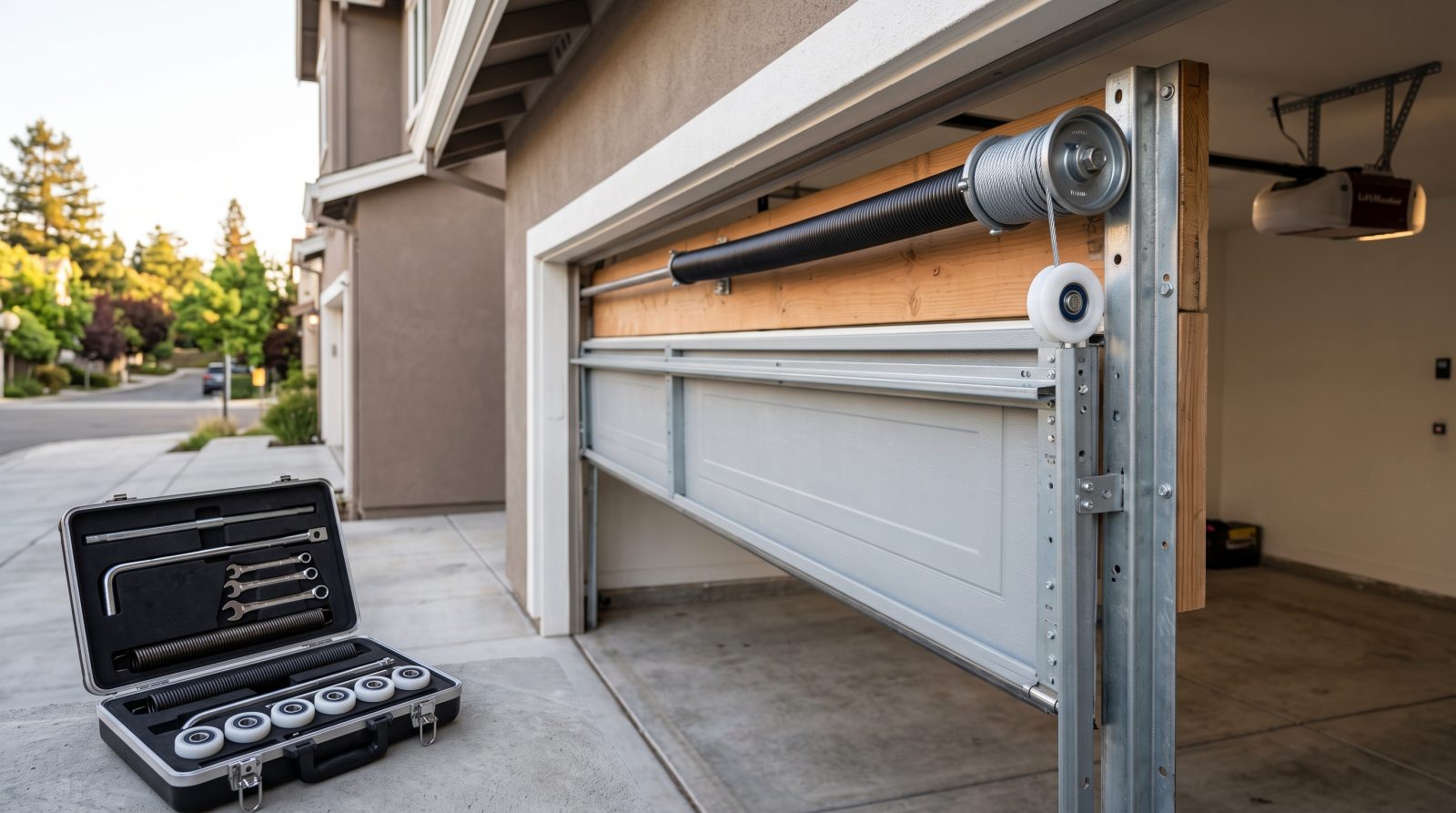
Springs are the most common failure and the most safety-critical. A torsion or extension spring is what counterbalances the weight of the door so the opener (and you) aren't lifting the full load. When one breaks, the door becomes extremely heavy and dangerous to operate. Springs are wound under enormous tension, which is why this is a job for a trained technician with the right winding bars and replacement parts — not a DIY project. Doors are typically built with springs rated for a set number of cycles, so on an older door it's often worth replacing both at once rather than paying a second service call when the surviving spring fails shortly after.
Cables and rollers are lower-cost parts but central to smooth, safe travel. Frayed or snapped cables let the door drop or hang crooked; worn rollers make the door grind, bind, and eventually jump the track. Replacing them is labor-light but precision work. Openers span the widest range: a simple fix like a worn drive gear, a failed capacitor, or misaligned safety sensors is inexpensive, while a dead logic board or a unit old enough that parts are scarce usually points toward replacement. A new opener's price is driven by horsepower (heavier and double doors need more), drive type (chain is cheapest, belt is quieter, screw and direct-drive vary), and smart features like Wi-Fi and battery backup — the latter being genuinely useful in Bay Area areas prone to power shutoffs.
Tracks and panels are where prices climb. A track that's merely loose or slightly bent can often be realigned affordably, but a crushed track needs replacement. Panel (section) replacement is the trickiest to price because matching the exact style, gauge, and color of an existing door — especially an older or discontinued model — can be difficult, and sometimes a multi-panel or full-door replacement ends up being the more sensible spend.
- Springs: high safety risk, specialized tools, often replaced in pairs on older doors
- Cables/rollers: lower part cost, precision install, big impact on smooth operation
- Openers: repair the small stuff; replace when the logic board dies or parts are obsolete
- Tracks: realign if bent, replace if crushed
- Panels: cost driven by style/color matching; full replacement sometimes wins out
What Drives Your Price Up or Down
Two homes with the same broken part can get different totals, and it's usually for legitimate reasons. Knowing these factors helps you anticipate where your job will land in the ranges above.
Door size and weight matter most. A single-car door uses lighter, cheaper components than a heavy double door or a solid-wood carriage-style door common on many Bay Area properties. Heavier doors need higher-rated springs and cables, which cost more in both parts and labor. Material and brand play a role too — premium insulated steel, full-view aluminum and glass, or custom wood doors carry pricier replacement sections and hardware than a basic non-insulated steel door.
Condition and age of the overall system can turn a one-part repair into a small project. If a spring snapped on a door that's also running on worn rollers, frayed cables, and a tired opener, fixing only the spring is a short-term patch. A good technician will tell you what's actually failing versus what can safely wait, so you can decide. Accessibility is another quiet factor: tight side rooms, low headroom, or doors blocked by stored belongings add time. Finally, the choice between a like-for-like budget part and a higher-cycle, longer-lasting component shifts the price — sometimes paying a bit more upfront genuinely lowers your cost per year of service.
- Single vs. double door, and overall door weight
- Material and brand (basic steel vs. insulated, glass, or custom wood)
- How much else on the system is worn or failing
- Standard part vs. higher-cycle, longer-lasting upgrade
- Accessibility — headroom, clearance, and what's stored around the door
Repair vs. Replace: When Each Makes Sense
Spending money to repair a door that's near the end of its life can be false economy, but replacing a door that just needs a $250 fix is the opposite mistake. A useful rule of thumb: if a repair costs a meaningful fraction of a new door and the door is old, heavily worn, or you're already facing multiple failures at once, replacement starts to make financial sense. If the door body is sound and just one or two components failed, repair is almost always the smart move.
Openers follow a similar logic. A unit that needs a single inexpensive part and otherwise runs well is worth fixing. But if the logic board is dead, the unit is old enough that parts are hard to source, or it lacks safety features that current units include, replacement usually delivers better value and reliability — plus modern conveniences like quieter belt drive, smartphone control, and battery backup that keeps you in and out during a power outage.
For panels, the question is often cosmetic plus structural. A single dented section on a newer door with an available matching panel is a straightforward repair. On an older door where the exact panel is discontinued, matching becomes a problem, and a full-door replacement may cost less hassle and look far better than a mismatched patch. The honest answer comes from an on-site look, which is exactly why we diagnose in person before recommending a path.
How to Get a Fair Bay Area Quote (and Avoid Overpaying)
The garage door trade has its share of bait-and-switch pricing, where a rock-bottom service-call ad turns into a sky-high bill once the technician is on-site. You can protect yourself with a few simple habits. Ask for the diagnosis and the price together: a trustworthy tech will show you the failed part, explain why it failed, and quote the specific repair before doing the work. Be cautious of anyone who insists you need a complete system overhaul to fix a single broken spring — that's sometimes warranted, but it should be explained, not assumed.
Get the price in terms of parts and labor, and ask what grade of part you're getting. A higher-cycle spring or a name-brand opener may cost more but last longer; a bargain part may not. Because we're a mobile service that comes to you anywhere in the Bay Area, we assess the actual door on-site rather than quoting blind over the phone, which means fewer surprises and a number that matches the real job.
Finally, think in terms of total value, not just the lowest sticker. A properly sized spring, fresh rollers, and a quick safety check during the same visit often prevent the next breakdown and the next service fee. If your door is acting up, the most reliable next step is a real-eyes diagnosis. Reach out for a free quote and we'll come to you, find the actual problem, and give you an honest estimate before any work begins.
- Insist on diagnosis + price together, with the failed part shown to you
- Be wary of full-system upsells used to fix one simple component
- Ask for parts-and-labor breakdown and the grade of part being installed
- Favor on-site assessment over blind phone quotes
- Weigh total value and longevity, not just the lowest advertised price