How garage door pricing actually works
Before comparing materials, it helps to understand what you're paying for. A garage door price is really three things bundled together: the door panels themselves, the operating system (springs, tracks, rollers, hinges, and often a new opener), and the labor to remove the old door and install the new one level and balanced. On a typical single-car (roughly 8–9 ft) or double-car (roughly 16 ft) opening, material is the single biggest lever, but it's rarely more than half the total once hardware and installation are included.
Two factors specific to the Bay Area quietly push numbers around. First, size and configuration: a 16-ft double door costs meaningfully more than two single doors' worth of panels because of the heavier hardware and torsion springs it requires. Second, insulation. Many older Bay Area garages were built uninsulated, and if your garage doubles as a gym, workshop, ADU, or laundry space, stepping up to an insulated (polyurethane or polystyrene core) door changes both the price and the day-to-day comfort. The ranges below assume a standard, modern sectional door installed by a professional; a bare builder-grade single can land under them and a large custom or fully insulated unit can land above them.
- Door panels: the material and style you actually see — the focus of this guide
- Hardware: springs, tracks, rollers, hinges, weather seal; wears out and is replaceable independently of the door
- Opener: often replaced at the same time, especially if upgrading to a quiet belt-drive or smart unit
- Labor: removal, install, leveling, spring tensioning, and safety testing — where a botched DIY job usually goes wrong
- Insulation: single-layer (none), double-layer (polystyrene), or triple-layer (polyurethane), each a step up in price and R-value
Steel garage doors — the Bay Area default
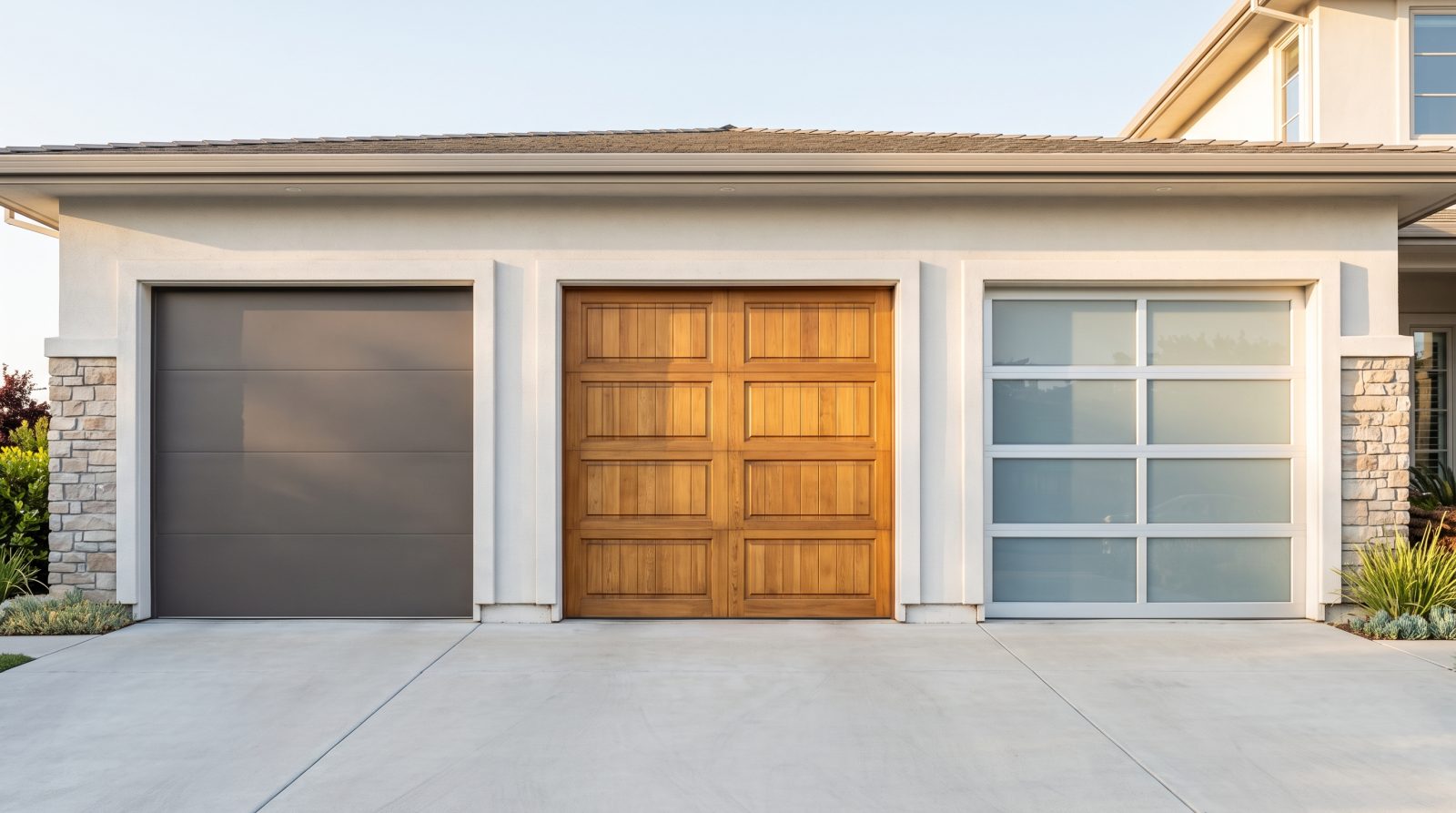
Steel is the most popular residential garage door material in the region for good reason: it offers the widest range of price points, holds up well to our generally mild but damp climate, and comes in single-, double-, and triple-layer (insulated) constructions. A basic single-layer steel door is the most affordable real option on the market, while an insulated, multi-layer steel door with a baked-on finish lands in the mid-range and is what most homeowners end up choosing. As a typical industry range, expect roughly $700–$1,500 installed for a single-car steel door and roughly $1,200–$3,500 for a double, with insulated and windowed versions toward the top — estimates that vary by size, gauge, and finish.
Steel's main weakness in the Bay Area is corrosion near the coast. Homes in Pacifica, the Outer Sunset, Alameda, or anywhere fog and salt air are a daily fact of life can see surface rust start at scratches and dents over the years, especially on thinner-gauge doors. The fix is choosing a heavier gauge with a quality factory finish and keeping the bottom seal intact. Steel also dents more easily than people expect — a basketball or a backed-into bumper can leave a permanent mark — so if your door faces a busy driveway, a thicker construction is worth the upcharge.
- Best for: most homeowners wanting durability and value with low maintenance
- Typical range: about $700–$1,500 (single) / $1,200–$3,500 (double), installed — varies by gauge, insulation, windows
- Watch-outs near the coast: choose a heavier gauge and keep the finish and seals intact to slow rust
Aluminum and full-view glass — the modern look
Aluminum-framed doors, especially the full-view glass style with large glazed panels, have become a signature look on contemporary Bay Area remodels, hillside homes with views, and converted garages used as living or studio space. Aluminum's big advantage is that it doesn't rust, which makes it genuinely well-suited to coastal and bayside microclimates where steel struggles. It's also lightweight, which is easier on the opener and springs over time. As a typical industry range, a basic aluminum door runs in the low-to-mid thousands installed, while full-view glass-and-aluminum doors are among the most expensive common options and can run several thousand dollars or more depending on glass type and size.
The tradeoffs are real. Aluminum is softer than steel and dents more readily, so it's a poor match for a door kids will be bouncing things off of. Full-view glass looks stunning but offers little privacy and modest insulation unless you specify insulated or frosted/tinted glazing — which matters in sun-exposed inland areas like Walnut Creek or the South Bay where an uninsulated glass door can turn a garage into a greenhouse. If the look is the priority, it's worth spending on the glass spec, not just the frame.
- Best for: modern aesthetics, view-oriented and coastal homes where rust resistance matters
- Typical range: low thousands for basic aluminum; several thousand-plus for full-view glass, installed
- Tradeoffs: dents easily; glass needs an insulation/tint spec for privacy and inland heat control
Wood, faux-wood, and composite — character vs. upkeep
Wood doors deliver a warmth and craftsmanship that no other material fully imitates, which is why you still see them on Craftsman bungalows in Berkeley and Oakland, on Spanish and Mediterranean homes in the South Bay, and on higher-end custom builds across the Peninsula. Real wood (cedar, redwood, mahogany) is a premium product: typical industry ranges put quality wood doors well into the thousands and custom carriage-house designs higher still. The honest catch is maintenance. Bay Area moisture, fog, and sun cycles are hard on wood, and a real wood door needs periodic refinishing or repainting — often every few years — to prevent warping, cracking, and rot. Budget for that upkeep, not just the install.
If you love the look but not the maintenance, faux-wood and composite doors are the practical middle path. These use a steel or composite core with a textured, wood-grain overlay or wrap, giving you much of the curb appeal with far less refinishing. Composite and faux-wood doors typically price between standard steel and real wood. For many Bay Area homeowners who want carriage-house charm on a foggy coastal street, a faux-wood-finished insulated steel door is the smarter long-term buy — it won't rot, and it shrugs off the damp that punishes solid timber.
- Real wood: premium price, highest character, ongoing refinishing required in our damp climate
- Faux-wood / composite: wood look with steel-or-composite durability; mid-to-upper price, far less upkeep
- Best for: Craftsman, Spanish, and custom homes where curb appeal justifies the spend
Fiberglass and the cost of the rest of the project
Fiberglass doors are a niche but useful option in the Bay Area. They resist salt-air corrosion and won't rot, can mimic a wood-grain look, and are lighter than steel — qualities that suit coastal homes. The downsides are that fiberglass can yellow or become brittle with years of UV exposure and cracks on hard impact rather than denting. Pricing typically sits in the mid-range, comparable to better steel or composite doors. For most buyers it's worth considering specifically when rust resistance and a wood look both matter and budget rules out aluminum-glass.
Whatever material you choose, remember the door is only part of the job. Springs and openers are consumables with their own price tags and lifespans, and they're often the reason a 'simple' replacement grows. A torsion spring replacement, a new belt-drive or smart opener, new rollers and weather seal, or hauling away the old door all add to a quote — but they're also opportunities to fix a noisy, unsafe, or failing system while the installer is already there. Because we work mobile across the Bay Area, the most accurate way to know your number is an on-site measurement against your actual opening, existing hardware, and the microclimate your door faces. If you're weighing materials for a replacement, call for a free estimate and we'll quote it straight.
- Fiberglass: rust-proof, rot-proof, wood-look; can yellow or crack with age and impact; mid-range price
- Don't forget: springs, openers, rollers, seals, and old-door removal can each move the total
- Get a real number: an on-site measurement beats any catalog price for your specific opening and climate