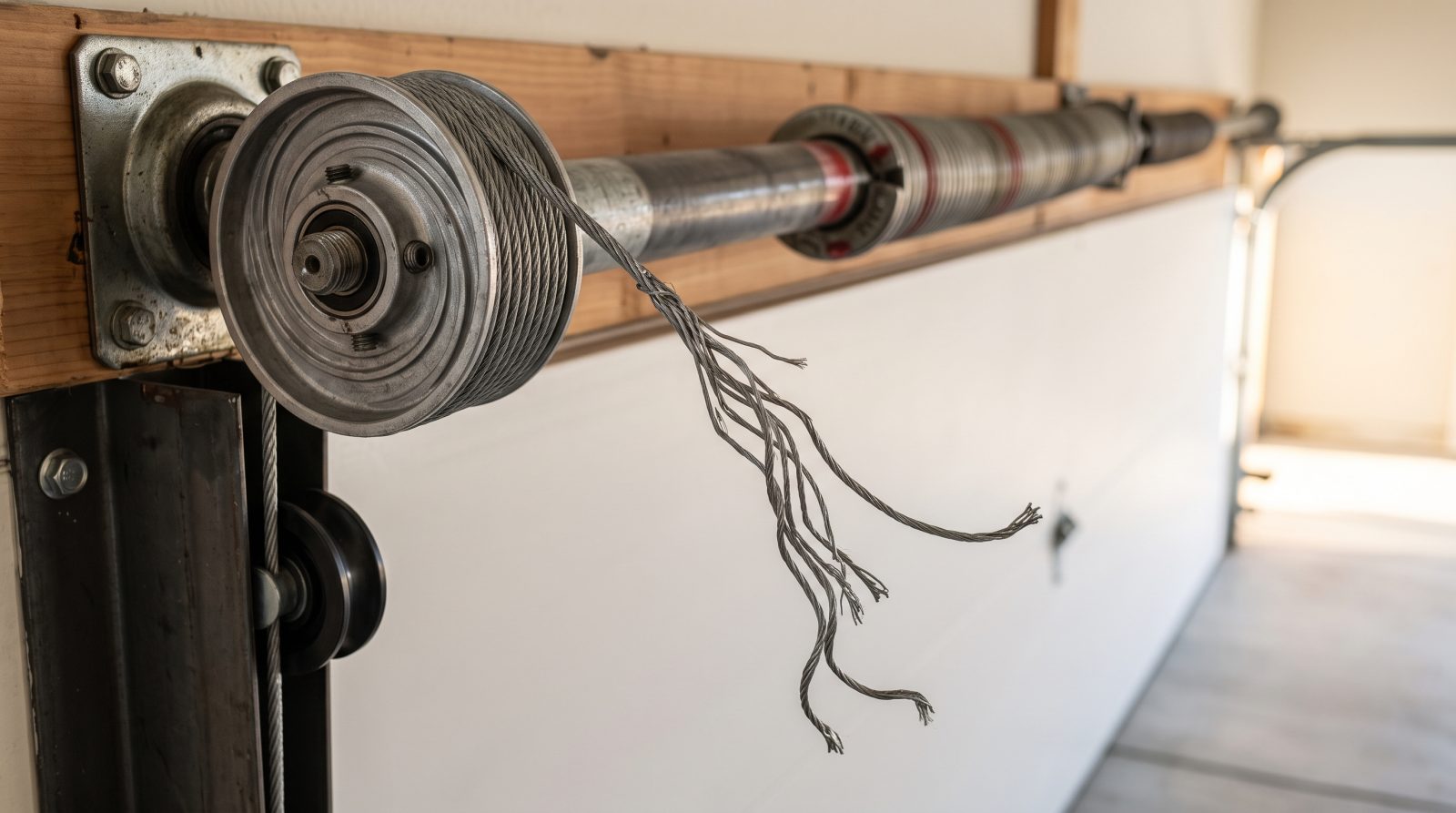
What garage door cables actually do (and why they fail)
Every overhead garage door has a pair of steel lift cables, one on each side, that connect the bottom of the door to a grooved drum at the top corner. On a torsion-spring system the springs do the heavy lifting and the cables transfer that force to raise and lower the door evenly; on an extension-spring system the cables run through pulleys and keep the stretching springs working in sync. Either way, the cables are what physically carry the weight of a door that can run from roughly 130 pounds for a single bay to well over 350 pounds for a wide, insulated double door. When a cable lets go, all of that load shifts onto one side in an instant.
Cables fail for a handful of predictable reasons, and most of them are about wear plus moisture rather than a single dramatic event. The steel strands fatigue from thousands of open-and-close cycles, fray where they wrap around the drum, corrode from humidity, or slip out of the drum groove when the door is forced or knocked off balance. In the Bay Area, the marine layer and coastal fog that roll through cities like San Francisco, Pacifica, and the Peninsula keep garages damp far more than people expect, and that persistent moisture quietly rusts cables, drums, and the bottom brackets they attach to. Homes closer to the bay or the ocean tend to see this faster than drier inland valleys.
- Repeated daily cycling slowly fatigues the steel until individual strands break
- Coastal fog and bay humidity accelerate rust on cables, drums, and brackets
- A door that is out of balance puts uneven strain on one cable, wearing it faster
- Forcing a stuck door, or backing into it, can pop a cable off the drum
- Old or undersized cables paired with heavier insulated doors wear out sooner
Warning signs your cable is failing before it snaps
Cables rarely fail without warning. The trouble is that the early signs are easy to ignore because the door still opens, just not quite right. Catching the problem in the fraying stage instead of the snapped stage is the difference between a quick, planned repair and an emergency with a door stuck shut over your car. It is worth taking thirty seconds every few weeks to look at the cables on each side and listen to how the door moves.
Look for a cable that appears to have loose, broken wire strands sticking out, sometimes called bird-caging, or that looks kinked, rusty, or thinner in one spot. Pay attention if the door starts to look crooked when it moves, sits unevenly when closed, or one bottom corner lifts before the other. A cable that has come off the drum will often leave one side sagging while the other stays tight. New grinding, scraping, or popping sounds, slack cable hanging loose near the bottom bracket, or a door that suddenly feels heavier or jerky are all reasons to stop using it and call for a look.
- Visible frayed strands, kinks, rust, or a thinning spot anywhere on the cable
- The door hangs crooked, racks to one side, or one corner leads the other
- Slack or loose cable dangling near the bottom roller or drum
- New grinding, popping, or scraping noises during travel
- The door slips, drops faster than normal, or feels heavier by hand
Why a broken cable is genuinely dangerous
A garage door cable is under tremendous tension, and that tension is the whole reason this repair belongs with a trained technician rather than a weekend project. When a cable snaps, the stored energy releases suddenly. The door can drop, slam, or twist in the tracks, and a frayed cable under load can whip. People are seriously injured every year trying to handle door springs and cables without the right tools or knowledge, and the most common mistakes happen exactly when someone is trying to nurse a failing door open one more time.
There is also a hidden risk in how the two cables work together. If one cable breaks and you keep operating the door, the remaining cable and spring now carry an unbalanced load, which can bend the track, crack the bottom bracket, or cause the door to jam diagonally. The bottom brackets where cables attach stay under spring tension even when the door is closed, so loosening the wrong bolt is one of the fastest ways to get hurt. The safe move when you suspect a cable problem is simple: stop using the door, do not park under it, disconnect the opener if the door is stuck, and leave the tensioned parts alone until a tech can release the load safely.
- Snapped cables release stored spring energy suddenly and can cause the door to drop
- Operating on one broken cable overloads the other side and can bend track or brackets
- Bottom brackets stay under tension even with the door closed, so they are not DIY
- If the door is stuck, pull the opener release and avoid parking beneath it
- Most cable and spring injuries happen while forcing a door that is already failing
How a proper mobile cable repair works
Because Bay Area Garage Door is a mobile service, the repair happens in your driveway. A good cable repair is never just swapping the one piece that broke; it is restoring the whole system to balance so the new cable does not wear out early. The tech starts by securing the door and safely releasing or controlling the spring tension, then inspects both cables, the drums, the bottom brackets, the springs, and the rollers, because a cable that snaps is often a symptom of an out-of-balance door or a worn drum that chewed it up.
From there the work is methodical: replace the damaged cable, and almost always its mate on the other side since they wear at the same rate, re-seat both cables cleanly in the drum grooves, set even tension so the door tracks straight, and check that the bottom brackets and drums are sound and rust-free. The tech then balances the door by hand, confirms it stays put at the halfway point, tests the opener's force and safety reverse, and lubricates the moving parts. On a typical residential door this is usually completed in a single visit. We will always tell you plainly if a rusted drum, a tired spring, or a bent bracket also needs attention rather than just putting a new cable on a worn system.
- Door is secured and spring tension is controlled before anything is loosened
- Both cables are typically replaced together, since they age at the same rate
- Drums, brackets, springs, and rollers are inspected for the root cause
- Cables are re-seated in the drum grooves and tensioned for straight, even travel
- Door balance, opener force, and safety reverse are tested before we leave
Cable repair costs and what affects the price
Homeowners always want a number, and the honest answer is that cable repair pricing depends on what the tech finds. As a typical industry range, replacing garage door lift cables commonly runs somewhere around 150 to 350 dollars for a standard residential door, with most straightforward jobs landing in the middle of that band. That figure is a general estimate, not a quote, and it varies by region, your specific door, the hardware, the material, and the full scope of what the inspection turns up. The only way to land on an accurate price is to have the door looked at.
Several things move the number. A heavier or wider double door, taller commercial-style sections, or premium hardware can raise the cost. If the cable failure already damaged the drums, bottom brackets, or rollers, replacing those parts adds to the total but prevents the new cable from failing again. Rust-heavy doors near the coast sometimes need more parts swapped than an identical door a few miles inland. We will walk you through exactly what is worn and what is optional so you can decide with full information, and we keep cables, drums, and common hardware on the truck so most repairs are finished in one visit rather than dragging across multiple trips. When you are ready, call for a free estimate and we will come to you.
- Typical industry range for residential cable replacement is roughly 150 to 350 dollars (an estimate that varies by region, door, material, and scope)
- Wider, heavier, or insulated double doors generally sit at the higher end
- Damaged drums, brackets, or rollers add parts cost but prevent repeat failures
- Coastal rust can mean more hardware needs replacing than on inland doors
- Common parts ride on the truck, so most repairs finish in a single mobile visit