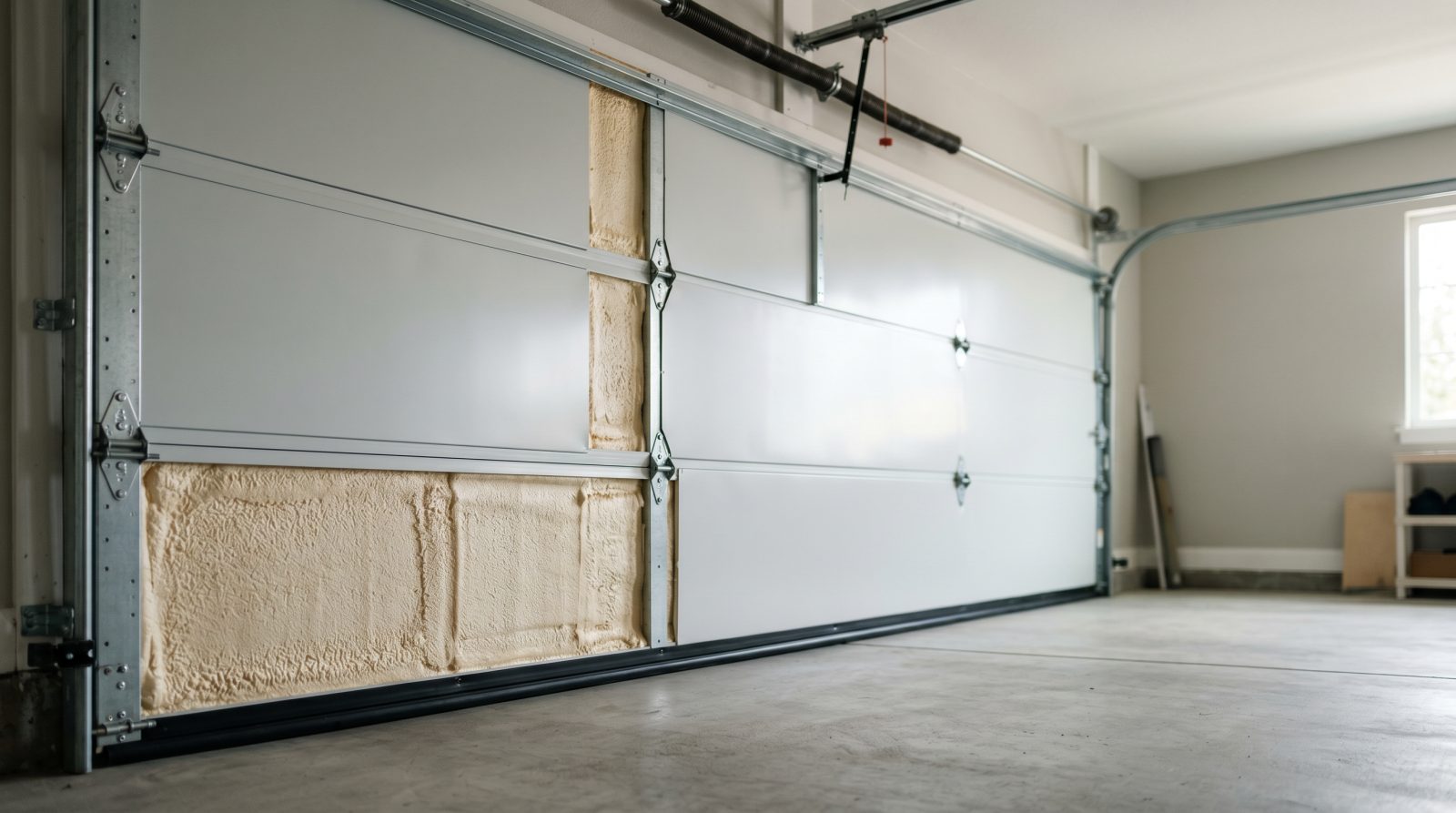
What R-value really means for a garage door
R-value measures how well a material resists heat flow. A higher number means more resistance and slower heat transfer. For garage doors you'll see two related numbers thrown around, and confusing them is the most common mistake homeowners make. The R-value of the insulation core is one thing; the effective R-value of the whole door assembly, including the steel skins, the frame, the gaps, and the perimeter, is almost always lower. A manufacturer might advertise an R-16 door when the real-world performance of the installed assembly is closer to R-9 or R-10 once thermal bridging through the metal and air leakage at the edges is accounted for.
For a non-conditioned Bay Area garage, you usually don't need a heroic R-value. The goal is rarely to keep the garage at 70 degrees year-round; it's to take the edge off the extremes, dampen temperature swings, reduce how much heat migrates into adjacent living space, and cut noise. In our climate, where hard freezes are rare and brutal heat waves are occasional rather than constant, a mid-range insulated door does most of the useful work. Chasing the highest R-value on the shelf often spends money on performance you'll never feel through an uninsulated garage wall and a gap under a side door.
The honest way to think about it: R-value is one input, not the whole answer. A perfectly insulated panel with a half-inch gap around the perimeter will still let conditioned air pour out. Sealing and insulation work together, and on most jobs the sealing is the part that's been neglected.
- Core R-value = the rating of the insulation material alone (marketing number)
- Assembly / effective R-value = how the whole installed door actually performs (the number that matters)
- Thermal bridging through steel and air leaks at the edges drag the real number down
- For most unconditioned Bay Area garages, a mid-range insulated door is the practical sweet spot
The main insulation methods, and where each one fits
There are four broad ways to insulate a garage door, and the right one depends on your door's construction, your budget, and what the garage is used for. Understanding the trade-offs up front saves you from buying a kit that won't actually fit your panels or from over-investing in a door that's on its last legs.
Factory-insulated doors are the gold standard. These are built as a sandwich: an outer steel skin, an insulation core, and an inner skin. Polyurethane-core doors are injected with foam that expands and bonds to both skins, which makes them more rigid, quieter, and better insulating per inch than the alternative. Polystyrene-core doors use pre-cut rigid foam panels slotted into the door; they cost less and still beat a single-layer door, but they don't bond to the skins and generally deliver a lower effective R-value. If you're already considering a new door, this is the cleanest path because the insulation, the seals, and the panel are engineered to work as a unit.
Retrofit kits let you add insulation to an existing single-layer steel door. They typically use rigid foam boards or foil-faced batts cut to fit each panel and held with clips or adhesive. On a flat or lightly ribbed steel door these work reasonably well and are a sensible weekend-scale upgrade. The catch is that they add weight, which can throw off the spring balance of your door, and they don't address the perimeter gaps where much of the loss happens. They're also a poor match for older wood doors or doors with deep decorative panels.
Spray foam and loose batt insulation are sometimes attempted as DIY shortcuts. We generally steer people away from spray foam directly on door panels: it adds uneven weight, can warp lightweight steel as it cures, and is nearly impossible to remove cleanly. Fiberglass batts left loose without a proper facing sag, trap moisture, and lose their value quickly. If a method makes the door heavier or wetter without a plan for balance and vapor control, it tends to create new problems.
- Polyurethane-core door: best insulation per inch, most rigid and quiet, higher cost
- Polystyrene-core door: budget-friendly, lower effective R-value, foam not bonded to skins
- Retrofit kit: good for flat/ribbed single-layer steel doors; watch added weight and spring balance
- Spray foam / loose batts: usually not recommended; weight, warping, and moisture risks
Don't forget the weather seals, this is where the Bay Area money is
On most of the doors we look at, the biggest comfort and efficiency gains don't come from the panel insulation at all, they come from sealing the perimeter. A garage door has four edges and a moving bottom, and every one of them is a potential air leak. The bottom seal (the flexible gasket that meets the floor) is the workhorse, and it's the part that cracks, hardens, and tears first, especially on doors that have baked in direct sun.
Bay Area garages have a specific seal problem: it isn't extreme cold, it's everything else. Coastal fog and marine air drive moisture and salt that degrade rubber and corrode hardware. Inland heat in places like the East Bay and the South Bay valleys cooks and cracks gaskets. Settling and slightly out-of-level floors, common in older homes built on fill or hillside lots, leave a wavy gap under the door that a worn seal can't bridge. The result is a door that looks closed but is breathing the whole time.
A full perimeter seal job typically includes the bottom astragal seal, the side and top weatherstripping (often a vinyl or PVC stop molding with a flexible flap), and a threshold seal on the floor for doors with a persistent gap or water intrusion. Threshold seals are especially worth considering for low-lying or driveway-sloped-toward-the-garage situations we see around the Bay during winter rains. Sealing is cheaper than re-insulating an entire door and frequently delivers the more noticeable result, less draft, less dust, fewer pests, and a quieter, more controlled space.
- Bottom seal (astragal): the first to fail; cracked or torn seals are the top quiet leak
- Side and top weatherstripping: stops drafts along the jambs and header
- Threshold seal: a floor-mounted strip for uneven floors and rain-prone driveways
- Marine air, salt, and inland heat are what age Bay Area seals, not deep cold
Insulation, your spring system, and safety
Here's the part DIY guides skip: adding insulation adds weight, and your garage door is a carefully balanced machine. The torsion or extension springs are sized to counterbalance the exact weight of your door so it opens smoothly and holds position. Bolt foam panels onto a door that was balanced for a single-layer panel and you can throw that balance off, which stresses the opener, accelerates wear, and in worst cases makes the door unsafe to operate.
After any insulation upgrade, the door should be tested for balance: disconnected from the opener, a properly balanced door lifted halfway will mostly stay put rather than slamming down or shooting up. If yours fails that test after you've added weight, the spring system needs adjustment to match the new load. This is also why retrofitting a heavy insulation kit onto a very old or already-marginal door is often false economy, you may be better served replacing the door with a factory-insulated unit engineered for the weight.
Garage door springs store enormous energy and are one of the more dangerous components in a home for the untrained to adjust. If your door feels heavy, jerky, or unbalanced after insulating, that's a signal to bring in a professional rather than to keep operating it. This is exactly the kind of follow-up our mobile technicians handle on a normal service visit.
- Insulation adds weight that can unbalance a door tuned for its original panel
- The halfway test: a balanced, opener-disconnected door roughly holds position at the midpoint
- An unbalanced door overworks the opener and wears parts faster
- Spring adjustment is a job for a trained technician, not a DIY torque guess
What it typically costs, and when it's worth it
Pricing for garage door insulation varies widely by door size, material, the method you choose, and the condition of the existing door and hardware, so treat the following as typical industry ranges and estimates rather than a quote. A retrofit insulation kit for a standard single-car door is generally a modest project; a double-car door roughly doubles the material. A full set of new weather seals (bottom, sides, top, and possibly a threshold) is usually an affordable add-on and often the highest-value dollar you'll spend. Replacing the door entirely with a factory-insulated polyurethane unit is the largest investment, and it makes the most sense when your current door is old, damaged, noisy, or already unbalanced.
Whether it's worth it comes down to how you use the space. If the garage is purely for parking and storage and shares few walls with living areas, basic seal maintenance is often all you need. If you've converted it into a room people spend time in, a workshop, gym, home office, studio, or laundry, then a combination of an insulated door and a complete perimeter seal pays off in comfort, lower noise, and reduced load on any space heater or AC you run. Homes where living space sits directly above or beside the garage benefit the most, because the garage temperature directly affects rooms you actually live in.
Our honest take for Bay Area homeowners: start by sealing, because it's cheap and frequently the difference-maker, then decide on panel insulation based on real use and the condition of the door. If you're unsure which path fits your specific door and how you use the space, that's exactly what a mobile assessment is for. Call for a free quote and we'll come to you, look at the actual door, and lay out the options without pushing you toward the most expensive one.
- Seal replacement: usually the lowest-cost, highest-value first move
- Retrofit kit: moderate cost; best on sound single-layer steel doors
- New factory-insulated door: highest cost; best when the existing door is old, damaged, or unbalanced
- Biggest payoff: garages used as living/work space, or with rooms directly above or beside them