What a Real Garage Door Tune-Up Actually Includes
A genuine tune-up is not a quick squirt of oil and a wave goodbye. It is a systematic inspection and adjustment of every component that bears load or affects safety, performed in a logical order so each adjustment builds on the last. The goal is to return the door to the smooth, balanced, quiet operation it had when it was new, and to flag any part that is wearing toward failure before it strands you.
On a typical visit we work through the whole system: the springs and their balance, the lift cables and drums, the rollers and hinges, the track alignment, the opener's force and travel settings, and the photo-eye safety sensors. Each of these interacts with the others. A door that is out of balance, for example, forces the opener to strain, which wears the gears and shortens its life. Correcting the balance often fixes a weak-opener complaint without touching the opener at all.
Because we are mobile, the entire tune-up happens in your driveway in one visit, with no need to drop anything off. We diagnose what we find on the spot and explain it in plain language before we touch anything that would change the bill.
- Spring inspection and balance test: checking torsion or extension springs for wear, rust, and correct tension so the door holds at the halfway point on its own
- Cable and drum check: looking for fraying, kinks, or slack and confirming the cables are seated and tracking evenly on both sides
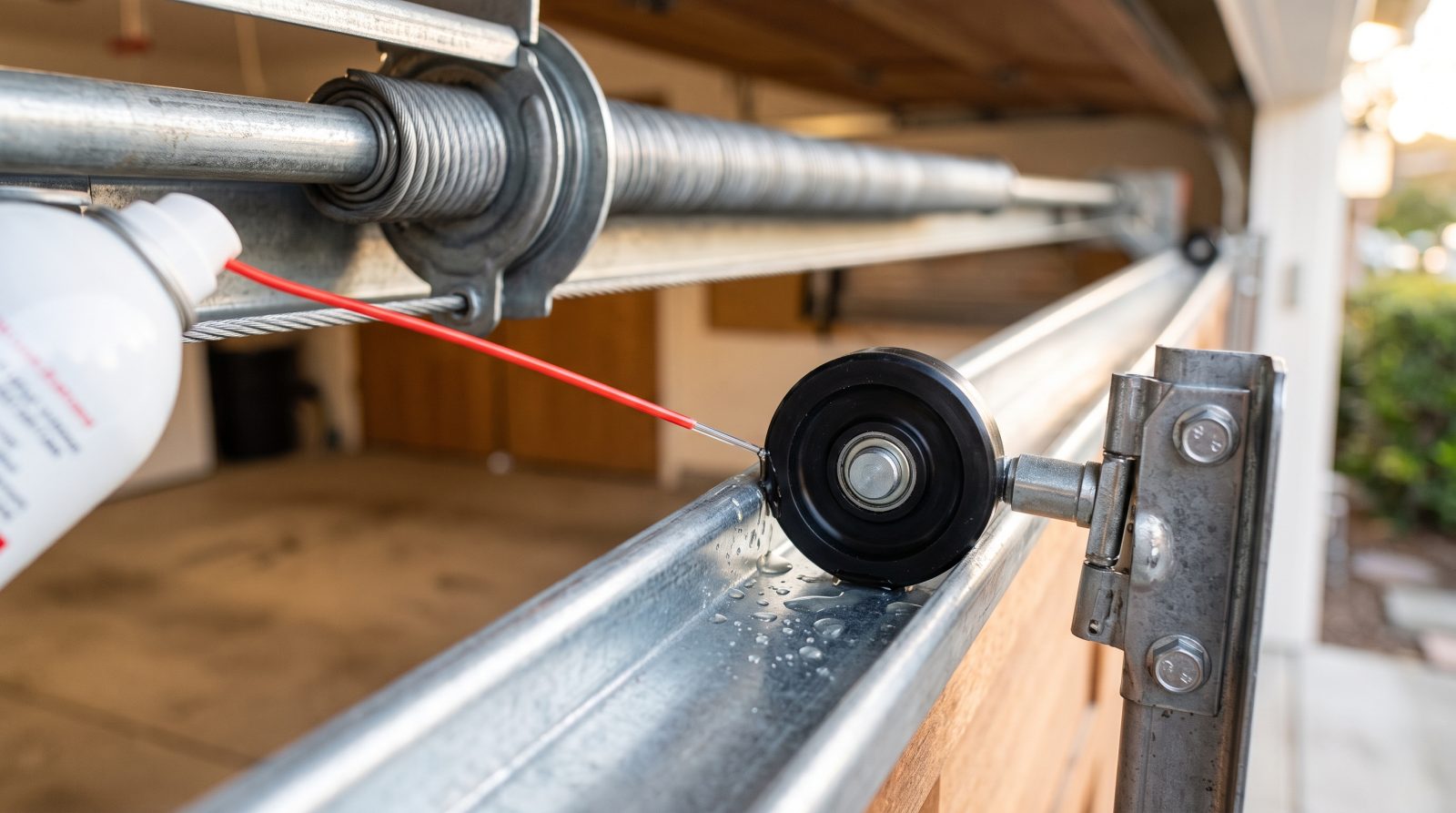
- Rollers and hinges: inspecting for cracked rollers, worn bearings, and loose or bent hinges, then replacing or lubricating as needed
- Track alignment and fasteners: verifying the tracks are plumb and parallel and tightening the bolts and brackets that vibration loosens over time
- Opener force and travel settings: adjusting open and close limits and the auto-reverse force so the door seals without slamming or bouncing back
- Photo-eye safety sensor test: confirming the door reverses when the beam is broken, the safety feature that protects kids and pets
The Hidden Hero: Lubrication Done Right
More garage doors get noisy, sluggish, and prematurely worn from bad lubrication than from almost anything else, and most of that comes from using the wrong product. The single most common mistake is reaching for WD-40, which is primarily a solvent and degreaser, not a long-term lubricant. It can actually strip the protective film off your hardware and leave parts drier than before, attracting dust and grit that grind down rollers and hinges.
A proper tune-up uses a dedicated garage door lubricant, typically a lithium-based or silicone-based product, applied to the specific points that need it and wiped clean where it would only collect dirt. The springs get a light coat to reduce the metal-on-metal friction between coils. The rollers, hinges, and bearings get lubricant where the moving parts meet. The opener's chain or screw drive gets the right product for its mechanism. Crucially, the tracks themselves are cleaned, not lubricated, because oil on a track just turns into a sticky paste of dust that the rollers have to fight through.
In the Bay Area this matters even more than in drier climates. Salt-laced fog rolling in off the ocean and Bay reaches inland through gaps in the hills, and that moist, mildly corrosive air accelerates rust on springs, cables, and fasteners. Regular lubrication lays down a protective barrier that slows that corrosion, which is why we often recommend a slightly more frequent maintenance cadence for homes in foggier coastal and bayside neighborhoods than for the inland valleys.
- Use lithium or silicone garage door lubricant, never WD-40, on springs, rollers, hinges, and bearings
- Clean the tracks rather than oiling them, so dust and grit do not build into an abrasive paste
- Wipe away excess so lubricant protects the parts instead of catching debris
- Foggy coastal and bayside areas benefit from more frequent lubrication because of salt-air corrosion
Spring Balance: The Adjustment That Protects Your Whole Door
The springs are the heart of a garage door. They counterbalance the weight of the door so that, when everything is adjusted correctly, the door is nearly weightless to lift and the opener barely has to work. When the springs lose tension or start to wear, that balance is lost, and the consequences ripple through the entire system.
The simplest way to test balance is to disconnect the opener and lift the door by hand to about waist height, then let go. A well-balanced door will stay roughly in place. If it slams shut, the springs are weak or undertensioned; if it flies up, they are overtensioned. Either way the door is now working against its own opener, which strains the motor, stresses the cables, and makes the door dangerous to operate manually. During a tune-up we test this balance and adjust torsion spring tension to bring it back into spec.
A word of honesty and safety here: garage door springs are under tremendous tension and store enough energy to cause serious injury if they are mishandled. Adjusting or replacing torsion springs is genuinely dangerous work that should be done with the right winding bars and technique, which is exactly the kind of task a mobile maintenance visit is built for. If we find a spring that is cracked, badly rusted, or near the end of its rated cycle life, we will show you what we see and explain your options rather than letting it fail on its own schedule.
Safety Checks That Keep Your Family Protected
A garage door is the heaviest moving thing most people interact with daily, and its safety systems are not optional niceties; they are the features that prevent a door from closing on a child, a pet, or the back of a car. A maintenance visit treats these systems as a priority, not an afterthought.
The two photo-eye sensors mounted near the bottom of the tracks project an invisible beam across the opening. If anything breaks that beam while the door is closing, the door is supposed to stop and reverse. Over time these sensors drift out of alignment, get bumped by a bike or a trash can, or simply collect enough dust and cobwebs to misread. We clean and realign them and then test that the reversal actually happens. We also test the door's mechanical auto-reverse by placing an obstruction so the door contacts it and confirming it backs off rather than pushing through.
Beyond the sensors, we inspect the cables for fraying that could let the door drop, check that the bottom bracket and other high-tension hardware are sound, and confirm the manual release cord works so you can get the door open during a power outage. We also look at the harder-to-see structural points, like whether the door panels and rollers show stress that hints at a deeper alignment problem.
- Photo-eye sensor alignment and a live test that the door reverses when the beam is broken
- Mechanical auto-reverse test using a physical obstruction at the floor
- Cable and high-tension hardware inspection for fraying, corrosion, and looseness
- Manual release check so you can operate the door safely during a power outage
Why Bay Area Conditions Make Maintenance Matter More
The Bay Area is really dozens of microclimates stitched together, and your garage door feels the difference. Homes in the Sunset, Pacifica, the Richmond, and other fog-belt neighborhoods live in damp, salty marine air for much of the year, which is hard on bare steel springs and cables. Move a few miles inland to the warmer valleys around San Jose, Concord, or Livermore and the issue flips to heat, dust, and bigger daily temperature swings that expand and contract metal and dry out lubricant faster.
Housing stock adds another layer. The region's older homes, from Edwardian and Craftsman houses in San Francisco and Oakland to mid-century ranches across the Peninsula and South Bay, often have garage doors and openers that have been retrofitted or are simply aging, where worn hardware and out-of-date safety features are common. Newer townhomes and condos throughout the Bay tend to have higher-cycle doors that see heavy daily use from busy commuting households. Both situations reward regular tune-ups: one to keep aging systems safe, the other to keep high-use systems from wearing out early.
Because we come to you, none of this requires you to leave the house or fight Bay Area traffic. We bring the maintenance to driveways across San Francisco, the Peninsula, the South Bay, the East Bay, and the North Bay, and we tailor what we check to the realities of your specific neighborhood and door.
How Often to Schedule and What It Typically Costs
For most homeowners, a once-a-year tune-up is the right baseline, ideally before the heaviest season of use or right after a wet winter that may have introduced rust. Homes in salty fog-belt areas, households that open and close the door many times a day, and any door that is already making new noises are good candidates for a check every six months. The point of a regular cadence is that maintenance is preventive: it is far cheaper and less disruptive to adjust a tired spring than to replace one that has already snapped and jammed the door.
As a general guide, routine garage door maintenance and tune-up service tends to fall in a modest range for a single residential door, with the price varying by the number of doors, what parts need replacement, and how much corrective work the door needs beyond a standard tune-up. Those figures are typical industry estimates that vary by region, door, material, and scope, not a fixed quote; the real number depends on your specific door, hardware, and what we find on inspection. If a tune-up uncovers a worn part like a cracked roller or a fatigued spring, we will explain the cost of addressing it before doing the work.
The clearest signs it is time to book are the ones you can hear and feel: grinding, squealing, or banging sounds; a door that jerks, hesitates, or moves unevenly; a door that no longer stays put when lifted by hand; or an opener that strains and struggles. Catching any of these early is what keeps a small maintenance visit from becoming a major repair. If your door is showing any of these symptoms, or you simply want the peace of mind of a system that has been checked end to end, call for a free quote and we will come to you.
- Annual tune-ups for most homes; twice a year for fog-belt, high-use, or already-noisy doors
- Costs are typical industry estimates that vary by door count, parts, material, and corrective work, not a fixed quote
- Book sooner if you hear grinding or banging, feel jerky movement, or the door will not hold its position by hand